Ticketing that keeps garments matched to the right move
In textile work, a ticket is doing more than naming a product. It needs to carry size, style, colour, batch or carton notes, and still survive handling from cut room to shelf or truck. That is where the right label face stock, adhesive and liner matter, because a weak roll can lift at the corner, smear under heat or leave residue on polybags and cartons.
For garment identification, stock coding and distribution handling, we usually look at the surface you are applying to first. Coated carton, plain kraft, plastic bag, folded fabric pack or corrugated case all ask for different adhesion and print behaviour. In humid coastal areas like Durban, and in unairconditioned stores or packing rooms, the label has to keep its grip when the air gets sticky and the pace picks up.
Paper, polypropylene and thermal stocks for textile rooms
Most textile ticketing jobs use one of three broad label face stock options. Direct thermal labels are printed by heat alone and suit short to medium life tickets, dispatch labels and fast moving internal coding. Thermal transfer labels use a ribbon and are better when the print must last longer, resist rubbing or stay legible on shelving and in transit. Facestocks can be paper, synthetic or a top coated material depending on how much handling the label will take.
- Paper face stock for carton marking, bundle tags and general warehouse use
- Synthetic face stock for moisture, scuffing and longer storage periods
- Top coated stock where sharper print and better resistance are needed
- Direct thermal rolls for speed, but not the best choice for long shelf life in heat or sunlight
- Thermal transfer rolls for stronger, longer lasting print with the correct ribbon
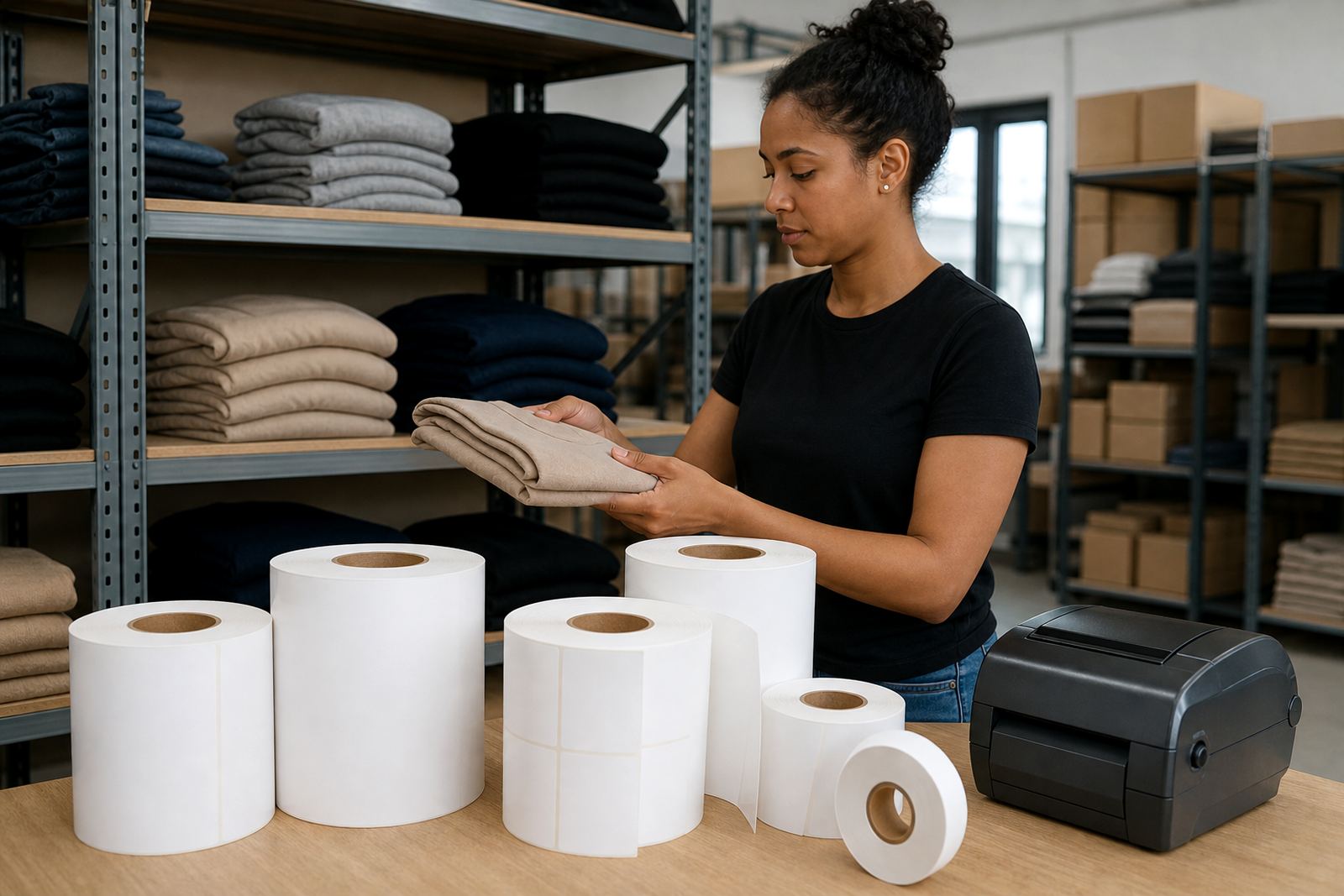
We also check whether your printer needs a 25 mm core, 40 mm core or 76 mm core. Benchtop printers, industrial units and some balance-table set ups all feed differently, so a roll that looks right can still jam if the winding direction or outer diameter is off. That is where printer fit checks save time and waste.
Adhesive choice for fabric packs, cartons and polybags
Textile ticketing often means one label type will have to work across more than one surface. A carton label may need a stronger tack than a bag label, while a label on wrapped stock may need a cleaner peel later. We look at permanent, removable and freezer type adhesive behaviour in practical terms, not just by name, because the real question is how the ticket behaves after pressure, dust and a few hours in storage.
If your team is applying labels by hand, the release from the liner matters too. A smooth liner helps with quicker stripping, while a poor unwind can slow down packers and cause double feeds. For small operations in Pinetown or Hammarsdale, that slowdown shows up fast. In larger plants sending stock to Johannesburg, Cape Town or Pretoria, a bad roll can create carton rework all the way down the line.
- Choose stronger tack for rough cartons and cold mornings in loading bays
- Use cleaner release where packers apply labels quickly by hand
- Match adhesive to surface, not only to printer type
- Ask for sample rolls before committing to a full run
Getting the layout right before you print thousands
Textile ticketing layouts are usually compact, but they still need room for the right information. A good label might carry an item code, garment size, colour, batch reference, carton count and a barcode or QR code. The trick is keeping the type large enough to scan and read when the label is folded or applied in a rush. If the artwork is crowded, the print may be fine on screen and unusable on the floor.
We normally advise a clear hierarchy. Put the most scanned detail first, then the human readable fields that warehouse and retail teams check by eye.On the production side, winding direction and repeat length need to be planned with the printer feed in mind, otherwise labels can come out upside down or off register.
- Allow space for barcodes and avoid squeezing text into the corners
- Keep size, colour and batch info in a fixed position on every ticket
- Check the printable width against your current printer model
- Plan roll length so staff do not stop mid-job for changeovers
Common textile ticketing mistakes we see on the floor
One common problem is choosing direct thermal for a job that needs long storage in a hot warehouse. Another is using a general purpose adhesive on dusty cartons, then wondering why the label lifts during transport. We also see rolls ordered with the wrong core size, which means the printer can not take the roll at all or starts slipping after a few hundred labels. These are small details, but they are the difference between smooth handling and a pile of rework.
Another mistake is ignoring the printer model entirely. Some teams run benchtop machines for sample runs and industrial printers for the main line, and each set up may need a different roll size or winding direction. In Westmead and across Durban, the busiest packing rooms often want the same label on multiple lines, but one roll format does not suit every machine. That is why usage review and repeat order planning matter as much as the first supply.
For budget planning, textile ticketing can sit anywhere from about R350 to R1 800 per roll set up for smaller runs, while larger or more specialised synthetic and thermal transfer formats may run from about R1 500 to R6 500 depending on size, core and adhesive choice. Final cost depends on quantity, slit width, label length and whether you need sample rolls or matched ribbons for thermal transfer printing.
How our Westmead team supports textile lines nationwide
From our base in Westmead, Pinetown, we handle textile ticketing requirements for garment makers, packers, wholesalers and distribution teams across South Africa. The work is practical: we look at the surface, the printer, the roll format and the handling conditions, then supply a label stock that fits the job. If you are distributing into Johannesburg, Cape Town, Pretoria or Pietermaritzburg, we can plan dispatch packing so rolls arrive ready for use and not loose in a carton.
Our team includes Sibusiso Lourens, Naledi Mdlalose, Johan Reddy, Ayanda Ntsele, Megan Moonsamy and Themba Kotze, and the process usually starts with a sample roll, printer fit check and a discussion on roll length planning. For textile ticketing, that small bit of planning saves time on the line and helps avoid waste when orders move quickly or need repeating in the same format.
- Custom slitting for the label width your line actually uses
- Rewinding and core sizing to suit your printer feed
- Adhesive matching for cartons, bags and wrapped stock
- Repeat order planning for regular garment and distribution runs