

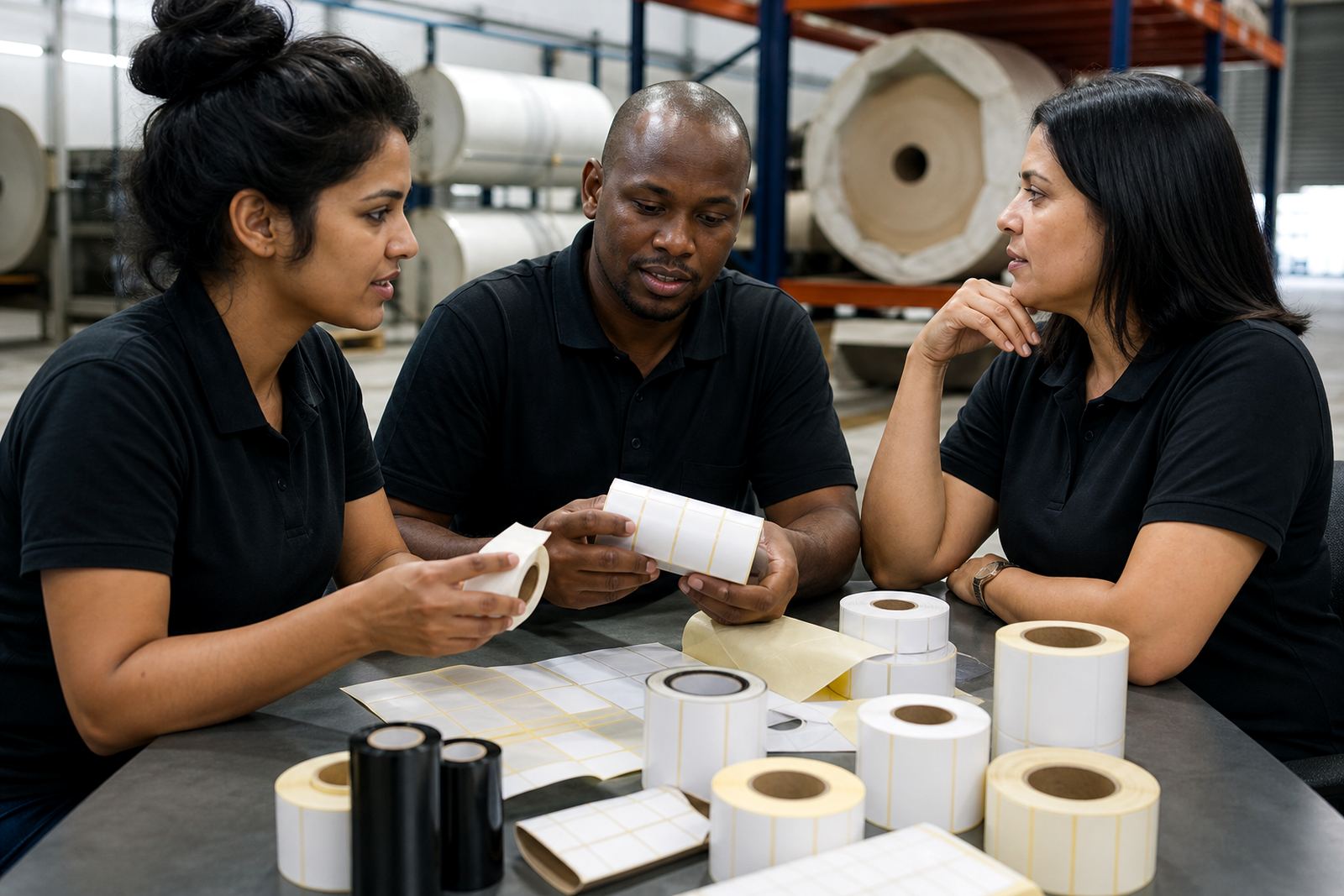
Why our rolls are specified before they are cut
That is where our work starts. We look at the substrate, the environment, the printer model, the label size and the way the product moves through packing, storage and transport. A good label should feed properly, print clearly and stay put, not lift at the corners or smear when handled. We supply face stocks and thermal rolls for businesses that need a practical fit, not just a roll that looks right on paper.
Our team spends time on the small details because those details change the end result. A glassy surface needs a different adhesive to a corrugated carton. A chilled pack calls for different hold than a dry goods shelf label. A printer with a 25 mm core wont accept every roll, and a direct thermal linerless format is not the same as a thermal transfer job that needs ribbon. We keep the conversation grounded in usage, so the order suits the process on the floor.
How we choose face stock, adhesive and liner
Self-adhesive labels are built from three main parts: the face stock, the adhesive and the liner. The face stock carries the print and can be paper or film depending on the application. Paper is often used for general packaging, retail labels and dispatch work. Film based stock is chosen where a tougher surface is needed, for example on moisture prone packs, chilled storage or products that are handled often. The adhesive must suit the surface and the conditions. Permanent adhesive holds firmly for long term use, while removable grades are better when labels must be lifted off without leaving too much residue. We also deal with freezer grade and high tack options when the surface is tricky or the temperature is low.
The liner plays a big part too, affecting feeding, matrix waste and how the roll travels through the machine. A matched liner supports clean stripping and neater winding. For some jobs, we suggest a narrower slit, a different unwind direction or another core size so the roll performs properly in the printer or applicator. There is no one format that suits every job, and that is often where the wrong stock begins to waste time. A label that feeds badly on a busy line can slow packing, and that is never a minor matter.
- Paper or film face stock selected for the job and surface
- Permanent, removable, freezer or high tack adhesive options
- Liner and roll format set to suit stripping and feed quality
- Core sizes matched to the printer or applicator setup
Thermal rolls for direct print and ribbon print systems
We supply thermal rolls in formats suited to both direct thermal and thermal transfer printers. Direct thermal stock is used where heat from the print head creates the image directly on the label face. It is common for short life labels, dispatch labels and retail use where the print does not need to last for years. It keeps the setup simpler because there is no ribbon to load, though the label itself must be chosen carefully for heat and light exposure. Thermal transfer stock uses a ribbon and is preferred when the print needs better resistance to abrasion, moisture or handling. That is often the better choice for product coding, asset labels and longer life identification.
Printer compatibility is part of the order discussion. We work with roll width, outside diameter, core size and winding direction so the stock feeds correctly in benchtop or industrial units. Some printers take 25 mm cores, others need 40 mm or 76 mm, and the outside roll size must leave enough room in the printer housing. If the winding direction is wrong, labels can present face up when the machine expects face down, which can stop a job dead. We check those points before dispatch so the roll matches the equipment on site, whether that site is in Pinetown or a warehouse in Pretoria.
What our Westmead team actually does with each order
From our base in Westmead, Pinetown, we handle custom slitting, rewinding, core sizing, roll length planning and winding direction. That means we can take a parent roll and convert it to a width and length that suits the customer’s line or printer. Sample rolls are available when a business wants to test the label on its own cartons, punnets, bottles or pouches before placing a larger order. We also carry out adhesive matching, face stock selection, printer fit checks and usage review so the next order is better aligned than the last one.
The production side is led carefully because consistency matters. When a customer repeats an order, we want the same feed, the same print result and the same dispatch packing every time. That kind of repeatability helps with stock control in retail, picking in logistics and batch traceability in manufacturing. If a job needs different winding or a different slit width, we plan it before it reaches the cutter, not after a box has already been packed wrong.
- Custom slitting for specific widths and line requirements
- Rewinding and core sizing for printer compatibility
- Sample rolls for testing on real equipment and surfaces
- Repeat order planning to keep later runs consistent
The people behind the roll, the packing tape and the schedule
Label Paper is led by Sibusiso Lourens, with Naledi Mdlalose handling sales, Johan Reddy supervising conversion, Ayanda Ntsele leading customer support, Megan Moonsamy planning production and Themba Kotze coordinating dispatch. That structure helps us keep orders moving without losing sight of detail. A label job is not only about the stock itself. It also depends on when a truck loads, how the cartons are packed, and whether a customer in Durban or Cape Town needs the order to fit a specific receiving window. We plan around those realities.
We do not treat communication as an afterthought. When a customer sends an enquiry through our contact page, we respond with the questions needed to pin down the application: what is being labelled, what printer is in use, what size the roll must be and whether the labels need to stand up to humidity, cold rooms or rough handling. That process saves waste and avoids guesswork. It also means the next order can be adjusted with less fuss, because the record is already clearer than it was the first time.
Where our stock goes, and what it must survive
We supply businesses across South Africa, including Durban, Johannesburg, Cape Town, Pretoria and Pietermaritzburg, as well as Hammarsdale and surrounding industrial areas. Different towns bring different conditions. Coastal humidity can affect adhesive performance and curl. Inland storage can bring dust and heat. Some sites run through power interruptions and need labels that load fast once the printers are back on. Our role is to help choose stock that keeps working in those conditions, instead of failing at the packing bench or in transit.
The right label is often the one that slips into the process without fuss. It feeds, prints, sticks and stacks without repeated checks. That is the level we work towards each day. Whether the order is for retail shelf marking, logistics scanning, carton sealing or coded batches, the aim is a result that is neat, readable and practical. A business should not have to wrestle with its labels. The stock must do its work and move on.