

A small start in Westmead with a practical brief
The founder’s first order was for label stock and thermal rolls that would print cleanly, stick properly and suit the printers used across KwaZulu-Natal. Based in Westmead, Pinetown, the business concentrated on products that could cope with humid coastal stores and busy inland distribution centres. That practical approach, which took shape in 2023, still guides how Label Paper serves South African businesses today, with self-adhesive label stock and thermal rolls selected for dependable performance in local conditions.
Rather than treat labels as a one-size-fits-all item, the early work centred on matching materials to real tasks. Some customers needed face stock that would take clear thermal transfer print for barcodes and product details. Others needed direct thermal rolls for fast-moving dispatch stations where ribbons would only slow things down. The aim was not to make the product sound fancy, just to make sure it did the job properly and held up in use.
How the material choices became the craft
As the customer base grew, so did the attention to detail around construction. A label is more than paper on a liner. The face stock, adhesive and backing all affect how the roll behaves through the printer, how it peels from the liner and how well it stays on cartons, tubs, bottles or outer packaging. That is where the real craft lives, and it is why the team spends time on selection before anything goes into production.
Different jobs call for different combinations. Permanent adhesives suit many shipping and general product applications, while removable options can help where a label may need to be lifted off later. Some liners feed better in certain machines, and some face stocks cope better with handling, moisture or scuffing. The work is to match those details to the customer’s process, not to push a material that looks good on paper but fails in a warehouse.
- Face stock options are matched to the print method and the surface the label must sit on.
- Adhesive matching helps with cartons, plastics, glass and other packaging materials.
- Core sizes and roll widths are planned so the roll fits the printer already in use.
- Winding direction and roll length are checked to reduce waste and stoppages.
The customers who shaped the company
The business has been shaped by the people who use labels every day. Retail teams want shelf-ready stock that prints clearly and keeps product information neat. Logistics operators need dispatch labels that scan properly and stand up to handling, sorting and the odd wet patch in transit. Manufacturers often need coding and identification labels that can move through packing areas without jamming machines or peeling at the edges.
Across Durban, Johannesburg, Cape Town, Pretoria and Pietermaritzburg, the common thread is not the sector but the pressure of time. A missed label can slow a pack line, hold up a dispatch or create confusion in store. That is why customers have leaned on practical support such as sample rolls, printer fit checks and usage review. These are not add-ons for show. They help reduce trial and error where every roll matters.
- Retail customers often need clean presentation and reliable shelf or product labelling.
- Logistics teams need strong adhesion and accurate print performance for movement and scanning.
- Manufacturing sites need consistent roll dimensions for coding, batch marks and carton identification.
- Smaller businesses often start with sample rolls before settling on a repeat order format.
The people behind the roll-up
Today the work is shared across a small team, and each role touches a different part of the process. Sibusiso Lourens leads the business as Managing Director and keeps the operation practical and responsive. Naledi Mdlalose handles sales and customer conversation, making sure the brief is understood before any material is cut. Johan Reddy oversees conversion, where slitting, rewinding and finishing need a steady hand and close attention to detail.
Ayanda Ntsele supports customers when they need guidance on stock type, printer fit or repeat ordering. Megan Moonsamy plans production so the right roll lengths and formats are lined up without unnecessary waste. Themba Kotze manages dispatch, which means packing orders carefully so they leave Westmead in good condition and arrive ready for use.
What the workshop learned from the real world
Working in South Africa means dealing with everyday conditions that do not stay neat for long. Labels may need to cope with heat, dust, moisture, uneven storage and handling in warehouses that run through busy shifts. In coastal areas, humidity can affect how stock behaves in storage. In inland depots, printers may run hard during peak dispatch periods and need rolls that feed evenly without curling or shedding adhesive too soon.
Those realities have pushed the business to stay focused on the details that matter most: adhesive strength, face stock suitability, liner behaviour, roll length planning and core sizing. Customers are not asking for theory. They want materials that work with the machines they already own and the packaging they already use. That is the reason the service list developed around the product itself rather than around broad promises.
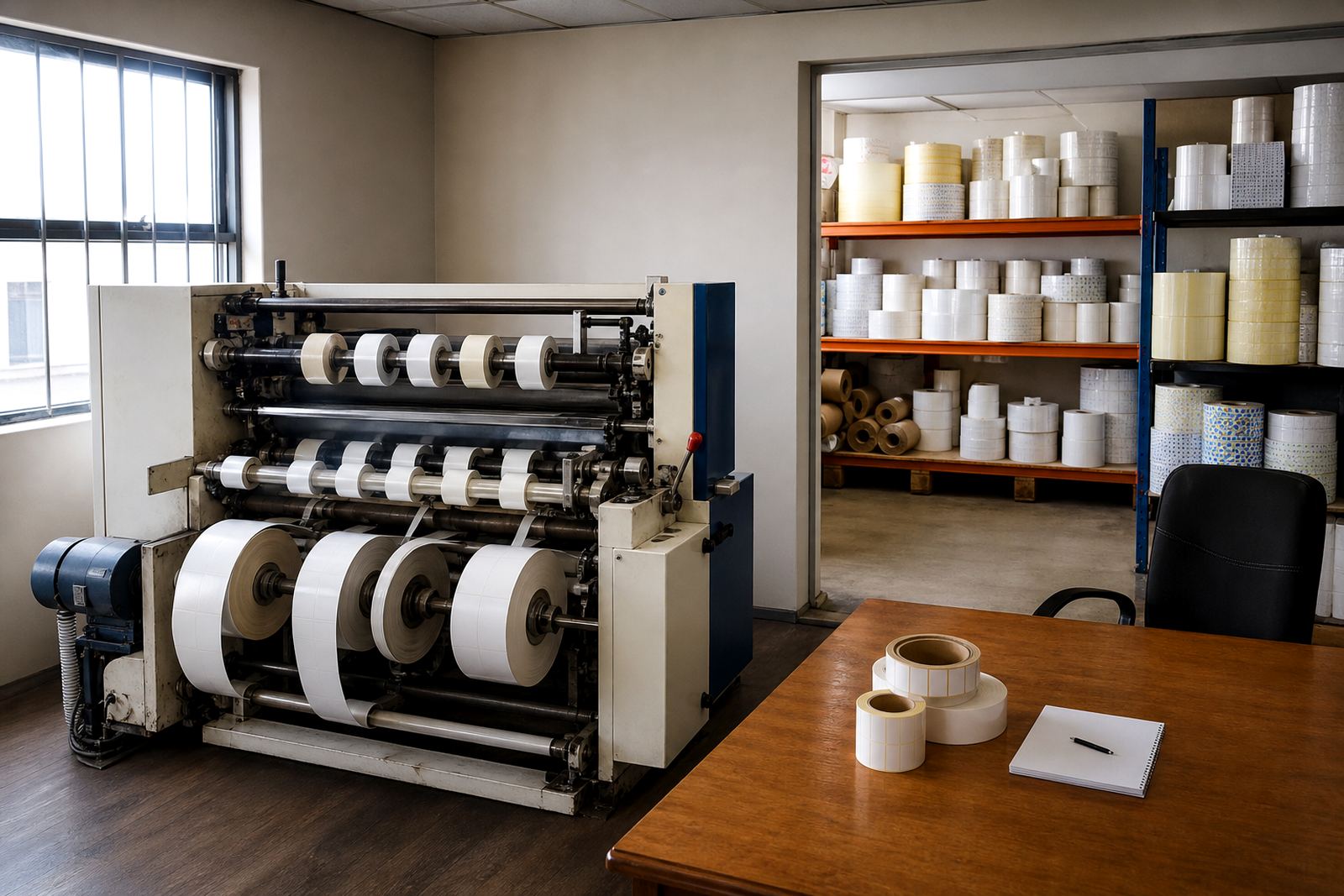
- Custom slitting for widths that fit the application and printer tray.
- Rewinding for better roll presentation and easier handling.
- Core sizing to suit benchtop and industrial printer requirements.
- Printer fit checks to avoid jams, skewing and wasted stock.
Where the story sits now
Label Paper now supplies self-adhesive label stock and thermal rolls to customers across South Africa, with the base still in Westmead, Pinetown and regular support reaching Durban, Johannesburg, Cape Town, Pretoria and Pietermaritzburg. The branches and area names used by the business reflect where the work is felt on the ground: Westmead Supply, Pinetown Supply, Durban Supply, Johannesburg Supply, Cape Town Supply, Pretoria Supply, Pietermaritzburg Supply and Hammarsdale Supply. The story is still rooted in practical supply, not in noise.
What has stayed the same is the way people are served. Customers reach out through the enquiry form on the contact page, then the team works through the brief, checks the printer, confirms the roll format and plans dispatch packing. Whether the order is for packaging, sealing, coding or general product identification, the focus remains on a neat fit, a clear print and a label that holds through the job.
That is the history in plain terms: a South African trade business started in 2023, shaped by local demand, built around careful material choice and kept alive by the people who depend on it every day.