Parcels that move from shelf to scan without fuss
Courier shipping labels have one job: carry a clear address, barcode or routing code through packing, sorting, road transport and final delivery. In Westmead and Pinetown, many dispatch teams work with mixed parcel sizes, so the label choice has to suit cartons, satchels, satchels with plastic film, and shrink wrapped goods without lifting at the corners.
For courier use, we usually look at a face stock that prints sharply and a pressure-sensitive adhesive that grips well on clean corrugate, mailing bags, or plastic pack surfaces. Where parcels may sit in a humid warehouse or move through coastal conditions, a stronger adhesive and a liner that releases cleanly can save a lot of rework. If your team packs in a hurry, the label also has to feed properly through the printer and peel without tearing.
The usual setup in a dispatch line
Most courier operations use one of three setups: thermal direct labels for short-life shipping labels, thermal transfer labels for longer legibility, or pre-printed label stock for mixed use. Direct thermal suits cartons moving out same day, while thermal transfer is better where labels must survive storage, cross-docking or longer road legs. If the parcel may be exposed to heat, sunlight or abrasion, a thermal transfer ribbon with the right face stock is often the safer choice.
- Address labels for parcel tops and side panels
- Routing labels for depot sortation and zone coding
- Consignment or waybill labels with barcodes and tracking numbers
- Return labels for outgoing parcels and courier despatch
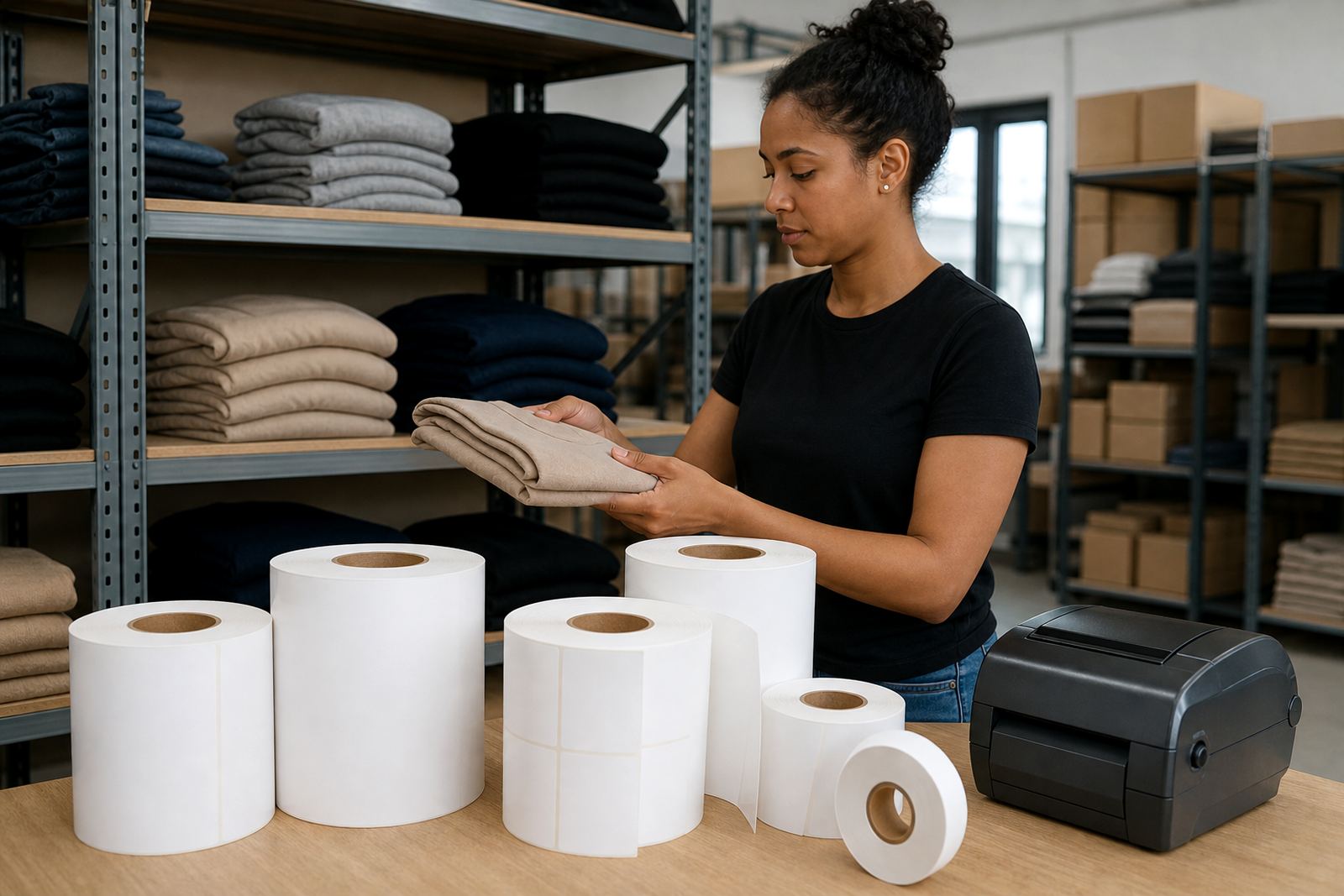
Roll size matters as much as the label itself. Common core sizes and outer diametres have to match the printer, whether that is a benchtop unit in a small fulfilment room or a larger industrial machine at a warehouse in Johannesburg or Cape Town. Wrong core size, wrong winding direction or poor roll length planning can stop a line for no good reason.
How to plan the label so the scanner does not argue with you
Courier labels need enough quiet space around the barcode, a clean print face and a layout that fits the printer’s print width. A label that is too small forces crowded text, while a label that is too large can cause wasted media and slower print cycles. We usually suggest checking whether the label will carry only the address, or address plus service level, route code, parcel number and customer reference.
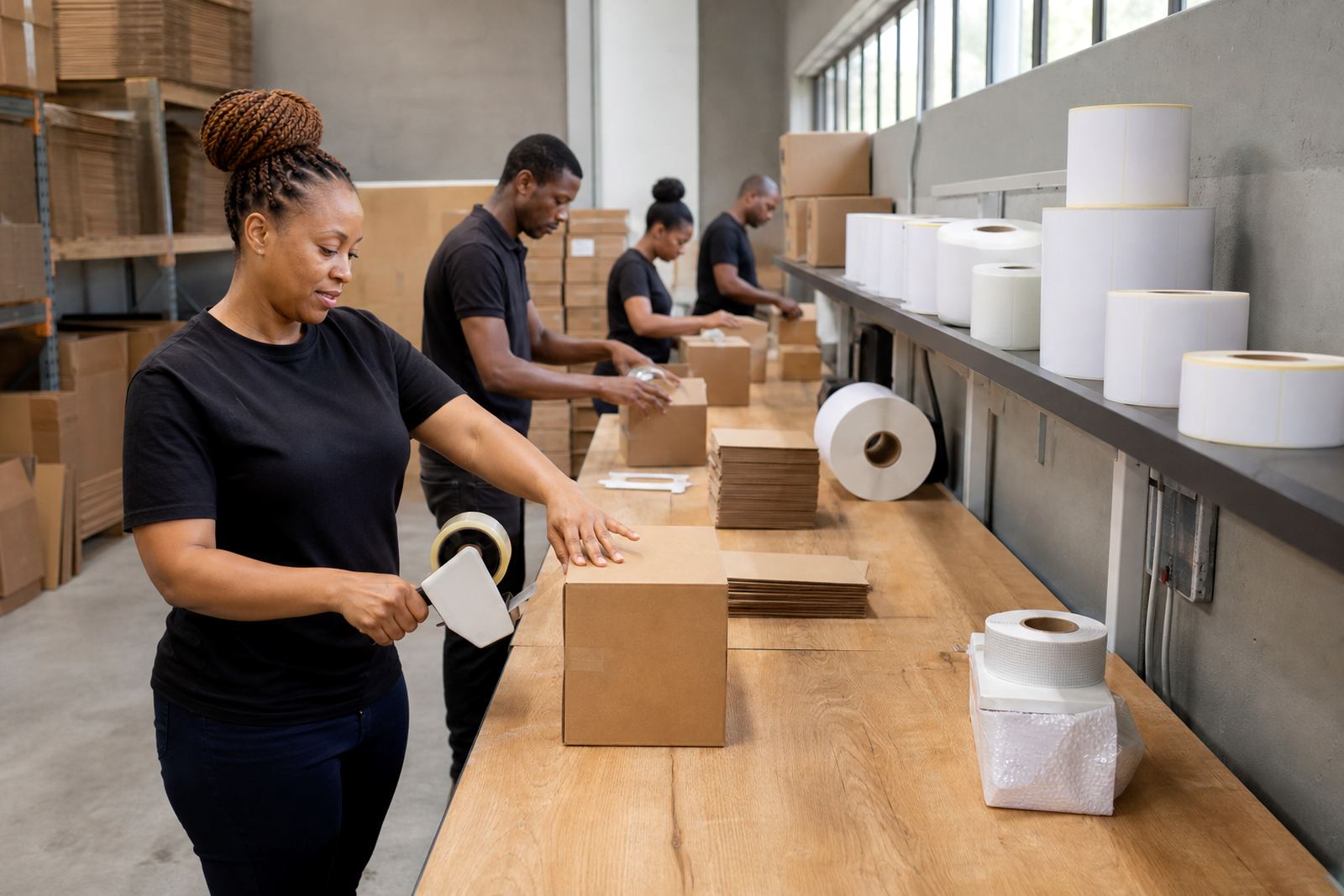
For busy packing tables, it helps to decide early whether the labels will be printed one-up or across a wider web, whether they need removable or permanent adhesive, and whether the liner must support fast dispensing. If labels are being applied by hand, a slightly stiffer face stock can be easier to handle. If they are fed through an applicator, the release and winding direction need to be set correctly from the start.
- Keep text large enough for manual reading at the depot
- Leave a clear quiet zone around every barcode
- Match adhesive to the parcel surface, not just the carton type
- Check that the printer accepts the core size and roll diameter
Common courier label mistakes that cost time
The biggest problems usually come from rushing the wrong material into the line. Direct thermal labels on parcels that sit in hot delivery vans can fade too quickly. A weak adhesive on recycled cartons can lift at the corners, especially if the box has dust or a rough crease. Labels that are too glossy for the printer setting can create scanning trouble, and a bad winding direction can jam the feed before the shift is halfway through.
Another issue is ordering the right face stock but the wrong liner or core. If the printer expects a certain inner core size and the roll is close but not exact, the team ends up trimming, shimming or reloading far too often.
- Testing only on one carton type, then discovering the adhesive fails on others
- Using a label that is too narrow for the courier data fields
- Choosing a low-cost roll that jams during high-volume runs
- Skipping sample rolls and then fixing problems after the print run starts
Budget ranges that make sense in Rand
Courier shipping label budgets depend on the roll size, adhesive type, face stock, whether the labels are direct thermal or thermal transfer, and how much slitting or rewinding is needed. Small runs for local dispatch rooms can be kept lean, while high-volume fulfilment sites need better planning because downtime costs more than the label itself.
As a broad working range, basic direct thermal shipping rolls for standard parcel use often sit in the lower end of the market, while specialist face stocks, stronger adhesives and custom roll formats move the budget up. Once core sizing, print direction and roll length planning are added, the price changes with the amount of conversion needed. For many courier and logistics buyers, it is better to compare the true cost per dispatch cycle, not just the cost per roll.
If you are shipping from Westmead to Durban, or feeding a multi-site network across Gauteng and the Western Cape, it helps to set one label standard and then adjust only where the parcel surface or printer model demands it. That keeps purchasing cleaner and reduces the odd mix of rolls that gathers in a cupboard.
What our team checks before a courier run starts
We work through the practical details before a run goes live: face stock selection, adhesive matching, printer fit checks, sample rolls, winding direction, and the right core size for the machine on site. The point is to make sure the label prints clearly, sticks properly and dispenses cleanly when the packing table is busy. Naledi Mdlalose handles sales questions, Johan Reddy oversees conversion, and Themba Kotze coordinates dispatch packing so the order leaves in the right form.
For clients in Pretoria, Pietermaritzburg, Hammarsdale and the larger metros, courier labels are often one part of a wider packaging mix. We can set up repeat order planning, review how the labels are being used, and suggest adjustments if the current stock is wasting print area or lifting on certain cartons. Sibusiso Lourens, as Managing Director, keeps the focus on reliable supply and proper finishing rather than guesswork.
- Sample rolls for testing on your actual printer and carton stock
- Custom slitting and rewinding for different machine widths
- Dispatch packing for bulk courier orders across South Africa
- Usage review when parcel volumes change seasonally
When courier labels need to do more than just stick
Courier shipping work is rarely static. One week it is small satchels with short delivery routes, the next it is mixed cartons moving through fulfilment and retail returns. The label has to stay readable through handling, stacking, barcode scans and the odd wet spell that comes with South African weather. That is why we look at the full route, not only the printer.
If your operation is expanding from a single packing bench to several dispatch points, it may be worth separating labels by use case: one format for same day local runs, another for longer freight movements, and a third for returns or shelf re-marking. That approach keeps the stock room saner and makes it easier for the team to pull the correct roll without slowing the line.