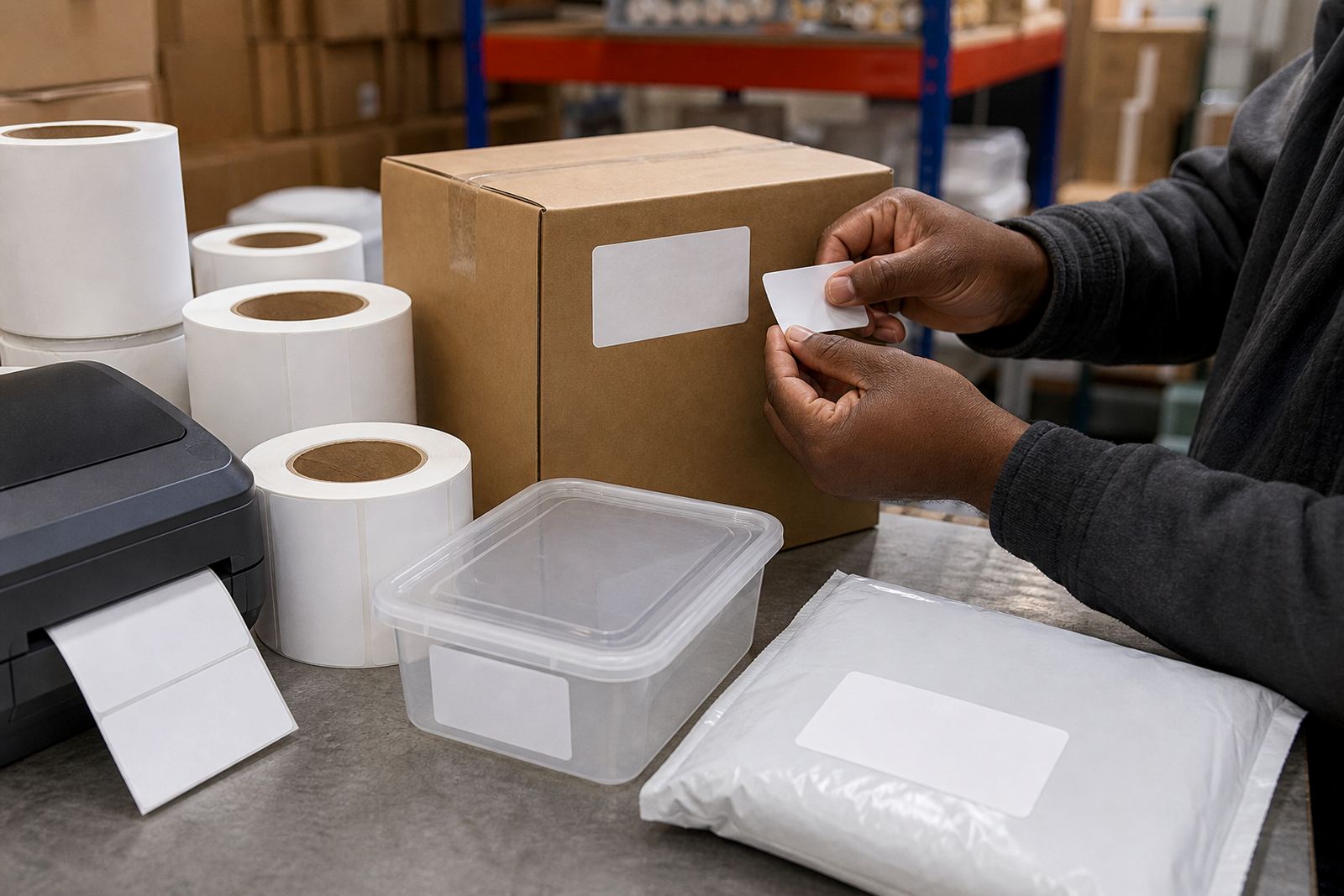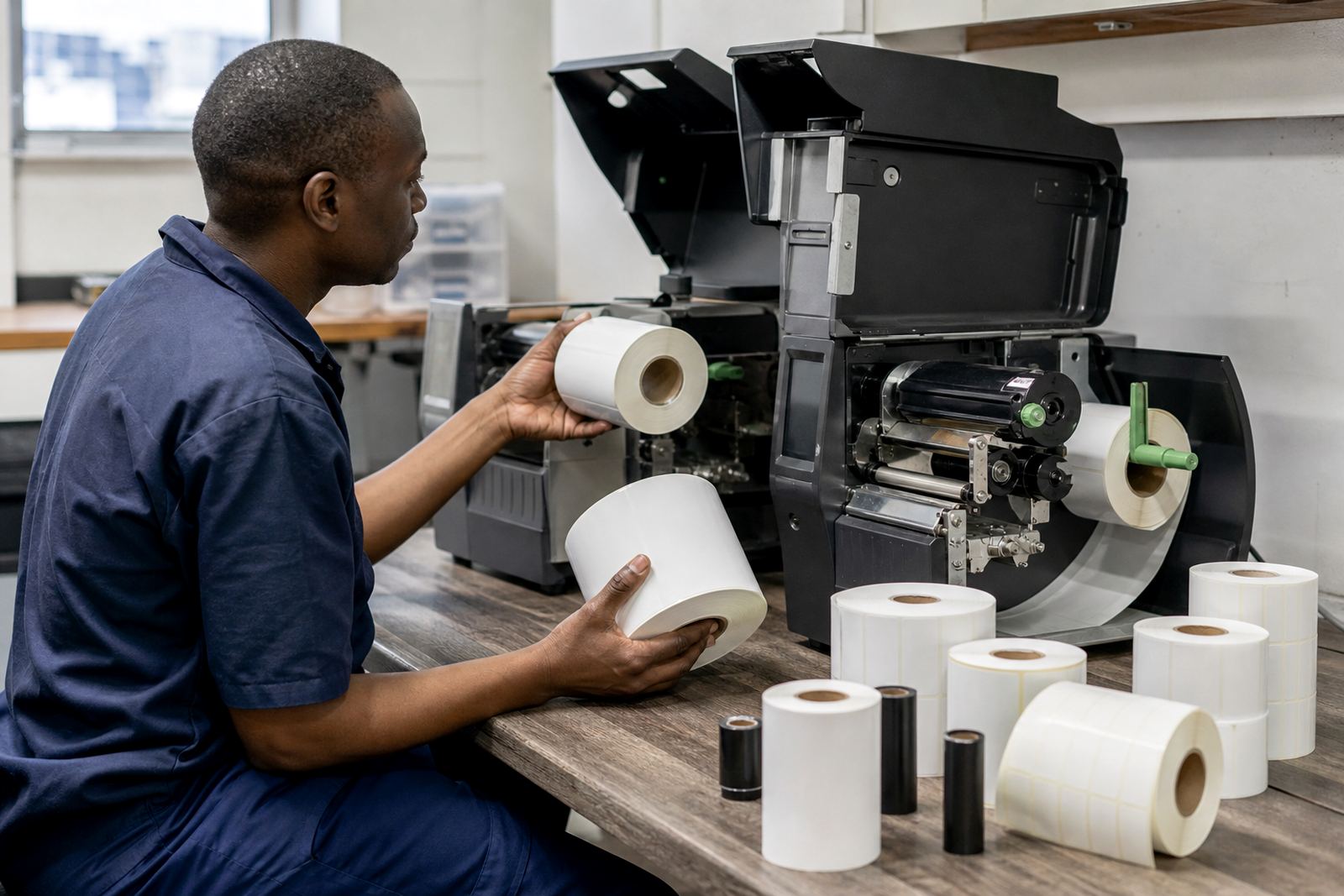
Choose the task the label must perform
Before you compare sheet sizes or roll widths, pin down where the label will live. A carton seal in a dry warehouse is very different from a stock label on chilled goods, a parcel label on a courier line, or a barcode tag that must stay readable in a busy picking area. Durban humidity, cold rooms in Gauteng and dusty depots in inland towns all affect performance.
Ask what the label must survive, then match the material to the task. A paper face stock works well for general packaging and dispatch use. A synthetic face stock is better where moisture, rubbing or handling can damage print. If the label needs to stay on during storage, transport and scanning, the adhesive matters just as much as the print face.
Check the face stock before you look at price
Face stock is the top layer that carries the print. For warehouse use, the main choice is between coated paper, uncoated paper and synthetic material. Coated paper gives a cleaner print surface for barcodes, item descriptions and shipping details. Uncoated paper can be used where print clarity is less demanding. Synthetic stock suits labels exposed to condensation, oils or repeated handling.
- Will the label be printed on a thermal transfer ribbon or by direct thermal heat only?
- Must the print remain readable for days, weeks or longer?
- Will cartons be chilled, frozen, stacked tightly or handled outdoors?
- Does the surface need a plain finish or a brighter, smoother face?
A good buyer checks whether the label face stock matches the product, the storage area and the way the goods move through the warehouse.
Adhesive choice decides whether labels stay put
The adhesive must suit the surface and the conditions. A permanent adhesive is the common choice for shipping labels, barcode labels and carton sealing where the label should stay in place. A removable adhesive may suit temporary warehouse marking or internal sorting, but it is not the first choice for parcels going out to customers. There are also special adhesive types for rough cartons, recycled board, plastics and chilled surfaces.
On cartons with dust, uneven fibre or moisture, adhesion can fail if the surface is not clean. In coastal areas like Pinetown and Durban, humidity can slow down cure and weaken grip if the wrong adhesive is used. For cold rooms and freezer stores, check whether the adhesive is rated for low temperatures before the order is released.
- Carton board: choose a general purpose permanent adhesive unless the carton is dusty or recycled.
- Plastic tubs or sleeves: ask for a tackier adhesive where needed.
- Chilled or frozen stock: confirm temperature performance before dispatch.
- Short term internal labels: removable may help if clean removal is required.
Roll format must fit the printer, not the other way round
Thermal rolls need to match the printer correctly. The main checks are roll width, roll diameter, core size, winding direction and gap or black mark layout. If any one of these is wrong, the printer can jam, misread the stock or waste labels during setup. That means lost time on the packing line and more rejects at dispatch.
Many benchtop and light industrial printers use 25 mm, 40 mm or 76 mm core sizes depending on the unit. Larger industrial printers often handle bigger outer diameters and wider stock. Always confirm the printer model, the core size and the maximum roll diameter before ordering. A roll that is too large can sit badly on the spindle, while a core that is too small may not feed at all.
- Measure the roll width in millimetres, not by eye.
- Check whether the printer takes direct thermal rolls or thermal transfer stock with ribbon.
- Confirm the required core size and outer diameter.
- Ask for the correct winding direction so labels print and peel properly.
Direct thermal or thermal transfer, choose for the shelf life
Direct thermal stock is coated to darken under heat from the printer head. It is popular for short life shipping labels, courier labels and temporary warehouse marking because there is no ribbon to fit. It is cost-effective, but the print can fade with heat, sunlight and friction. Thermal transfer uses a ribbon to place the image on the label face, which gives better durability and longer lasting barcodes.
If you are labelling stock for same-day dispatch, direct thermal may be enough. If labels must survive storage, transfer between sites, or longer shelf time, thermal transfer is usually the safer choice. A warehouse buyer should decide based on how long the print must stay readable, not only on unit cost.
Sizing, slitting and rewinding save time on the floor
Label stock often needs to be converted to suit the packing line. Custom slitting can turn a wide master roll into narrower rolls for multiple stations. Rewinding helps when the unwind direction or roll build needs to suit a different machine. Core sizing matters when different printers are used across one warehouse or between branches in Johannesburg, Cape Town or Pietermaritzburg.
Planning the roll length also helps reduce stoppages. A short roll may be fine for trial work, but a busy dispatch line needs enough length to avoid frequent changeovers. If the buyer knows daily usage, print volume and label size, roll length planning becomes much easier and waste drops.
- Match roll width to the label applicator or printer tray.
- Set a core size that fits all intended machines.
- Choose a roll length that reduces changeovers during peak dispatch.
- Confirm winding direction for peel and print flow.
A warehouse checklist before the order leaves your table
Use a short checksheet before you place the order. It saves rework, delays and returned stock. The more sites you supply, the more important it is to keep the spec consistent across branches and packing teams. One wrong roll can interrupt an entire picking bay.
- Label size in millimetres
- Face stock type for the application
- Adhesive type for the surface and temperature
- Direct thermal or thermal transfer
- Core size and outer roll diameter
- Printer model or printer family
- Winding direction and roll orientation
- Dispatch packing needs for transport across South Africa
For warehouse buyers, the best order is the one that prints cleanly on day one and still works after the stock has moved through storage, loading and delivery. That is where sample rolls, printer fit checks and usage review make a real difference.