When one extra millimetre changes a whole shift
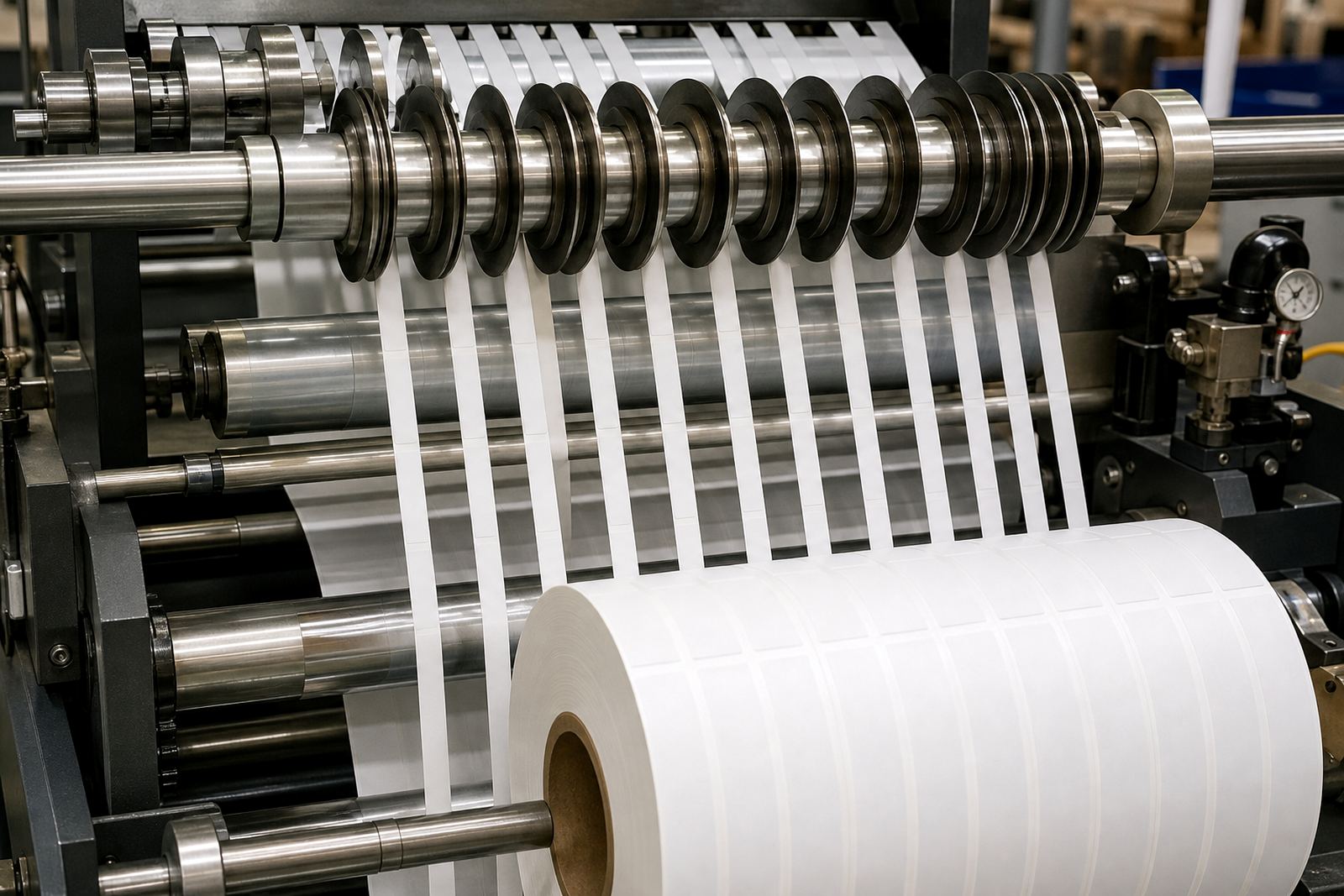
Slitting is the cut that turns wide parent rolls into working rolls sized for a printer or application. If that cut wanders, the roll can track unevenly, edges fray, and the label web may shift as it runs through a benchtop printer, a high speed applicator or a hand applied pack station.
In practical terms, a roll that is 2 mm too wide may rub the side walls of the printer path or pack too tightly on the core. A roll that is too narrow can telescope, loosen under tension, or leave a poor edge that catches on the guides. That is why slit accuracy is not a nice extra, it is part of feed reliability and waste control.
How slit consistency protects the label face and adhesive
Many people only think about width, but a clean slit also protects the face stock, adhesive and liner. A rough cut can leave fibres hanging on paper labels, or create a lifted edge on film stock that starts peeling before the roll is even loaded. Once that begins, the operator often blames the printer when the real issue is the roll build.
The adhesive matters too. Some permanent adhesives are tacky enough to grab the liner edge if the slit is rough, while removable adhesives can wrinkle if the tension is uneven. On hot days in Durban or humid conditions near the coast, poor roll finish can show up quicker because the materials soften and breathe differently.
- Sharper cuts help prevent edge fray on paper face stocks.
- Even tension reduces telescoping during transport and storage.
- Clean edges help labels release from the liner at a steady rate.
- Better slit rolls waste fewer labels at setup and during changeover.
Core size, winding direction and printer fit are part of the same job
Slitting is never only about the cut width. Core size, winding direction and roll length planning have to line up with the printer or applicator using the roll. A 25 mm core suits some compact printers, while larger label runs may need a 40 mm or 76 mm core for heavier rolls and industrial feed systems.
Winding direction also changes how the label faces enter the machine. If the image side or adhesive side faces the wrong way, the roll may still look correct on the pallet but fail the first time it is loaded. That is why printer fit checks matter before dispatch, especially when a site uses more than one model across packing and dispatch.
- Check core size against the spindle or holder before production starts.
- Match winding direction to the printer path and peel edge.
- Plan roll length so the job finishes without mid-shift changeovers.
- Keep the same build across later supply so operators do not need to reset every time.
A Westmead order can fail in Pretoria if the slit is off
We see this often with national supply. A roll that runs well in Westmead may behave badly once it gets to a packing line in Pretoria or Johannesburg because the machine setup is a bit different, or because the roll was packed too tightly for a longer road trip. On paper the labels are the same, but if the slit is inconsistent the real-world result changes fast.
For example, a warehouse in Pietermaritzburg may use a thermal transfer label for stock coding, while a retail team in Cape Town uses a direct thermal roll for short shelf labelling. Both can need the same face stock width, but the slit tolerance, core size and winding direction can be different. That is where careful roll planning saves time and avoids scrap.
Why waste control starts at the slitting table
Waste control is not only about using every metre of label stock. It also includes fewer test prints, fewer rejected rolls and less time spent clearing jams. When slit widths are consistent, operators spend less time checking the first few labels and more time moving finished product. That improves throughput without needing to push the machine harder.
Good planning also helps with follow-on supply. If the same product line keeps moving through the slitting room with the same width, core and adhesive, the next order can be set up with less trial and error. In a busy plant, that saves more than a few minutes, and it avoids the mess of half-used rolls lying around waiting for the right job.
- Consistent slit widths reduce setup scraps.
- Correct roll length planning lowers the number of changeovers.
- Matched adhesive and face stock reduce rejected labels.
- Rewound rolls store neater, so stock control is easier.
What to ask for before the roll leaves the floor
If a label roll is going onto packaging, retail or logistics lines, the slitting brief should be clear from the start. Give the face stock type, adhesive choice, liner preference, required width, core size and the printer or applicator model. That allows the roll to be cut and rewound for the actual job, not just for a standard size that may be close but not right.
At Label Paper in Westmead, Pinetown, we handle custom slitting, rewinding, core sizing, winding direction, sample rolls, adhesive matching and printer fit checks for customers across South Africa. For operations in Hammarsdale, Durban, Cape Town, Pretoria, Johannesburg and Pietermaritzburg, that detail matters because a small error in roll build can slow down an entire line.
When the slit is right, the roll feeds better, stores better and wastes less. It is a small cut with a very direct effect on the floor.