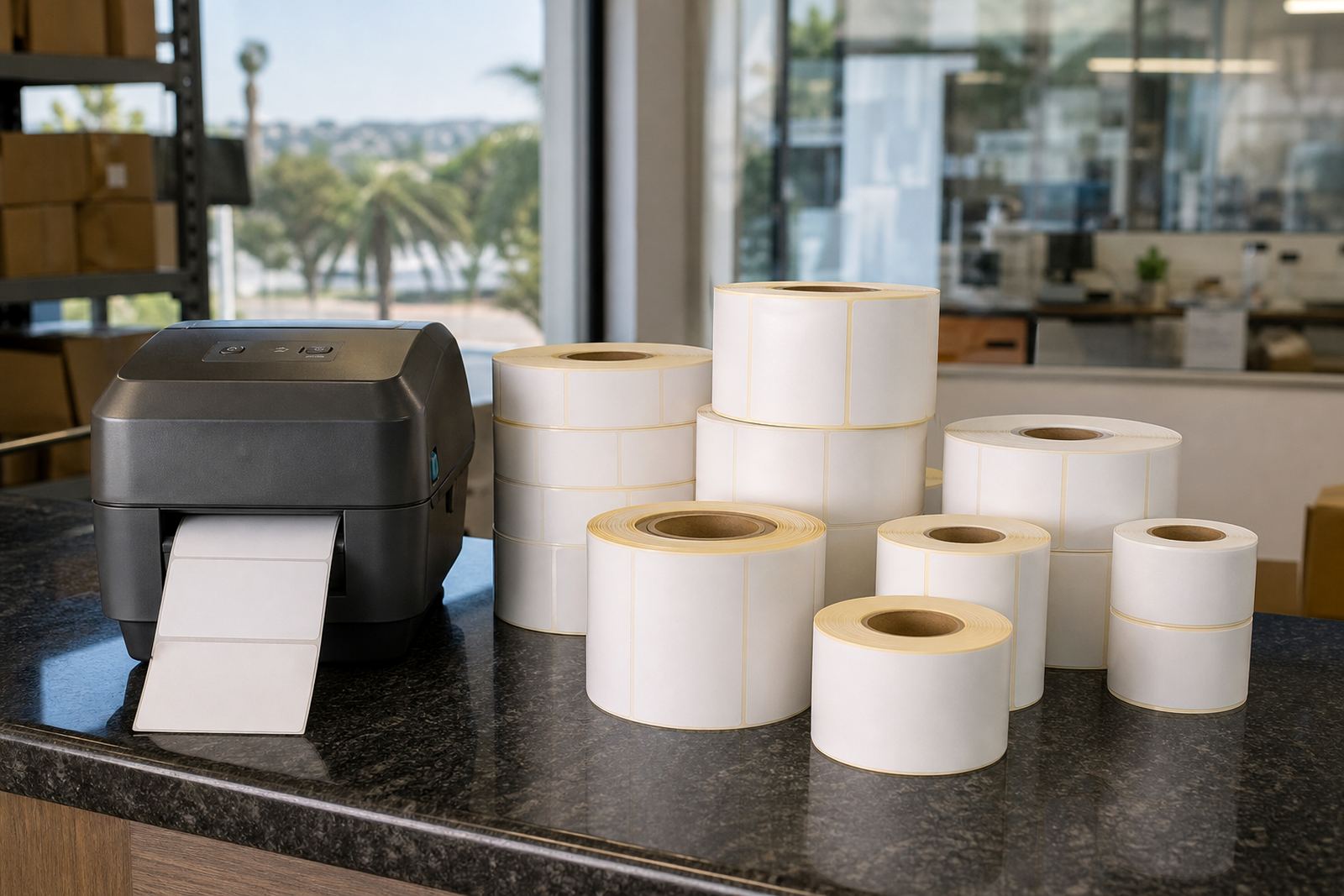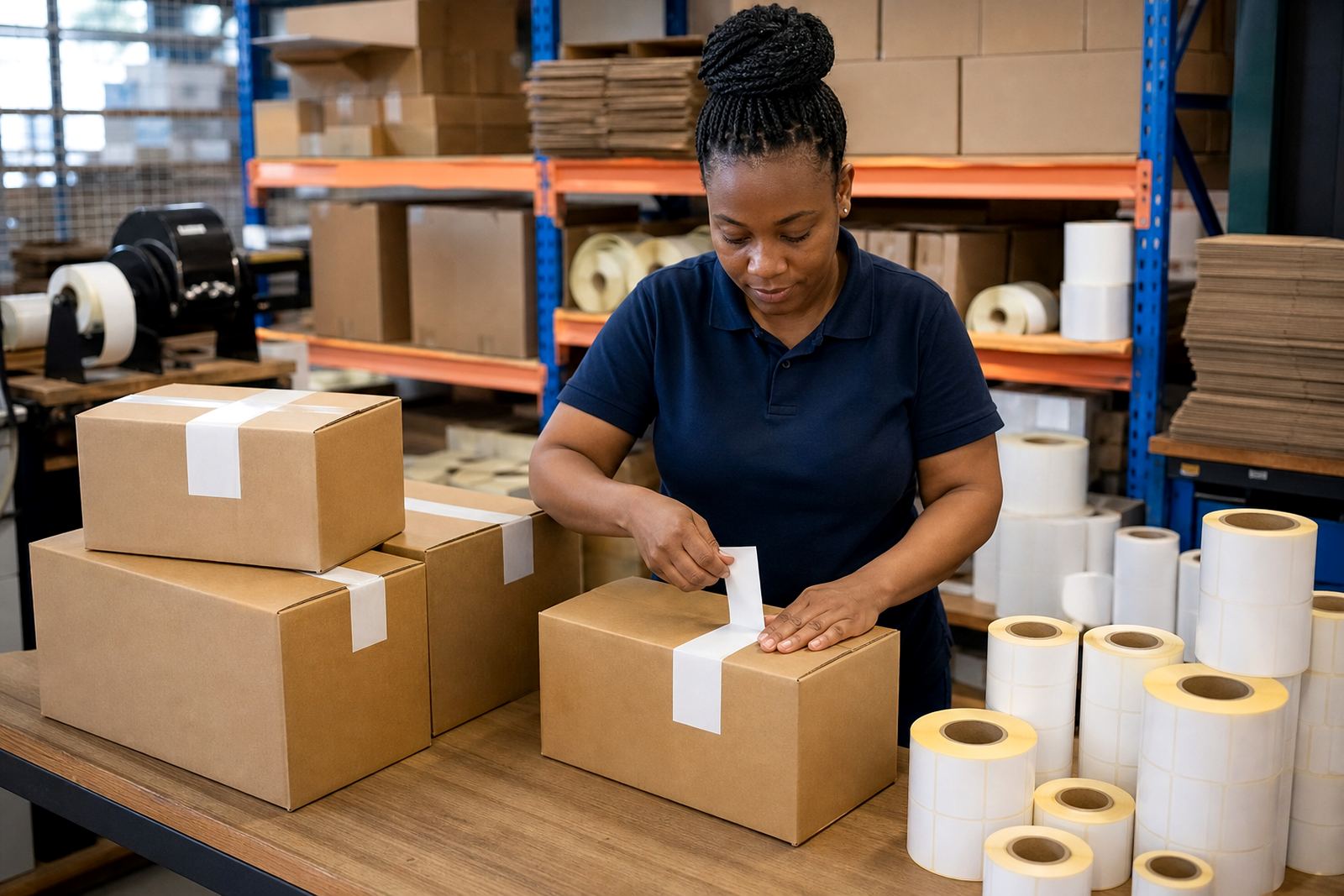
The roll has to suit the workbench, not only the printer
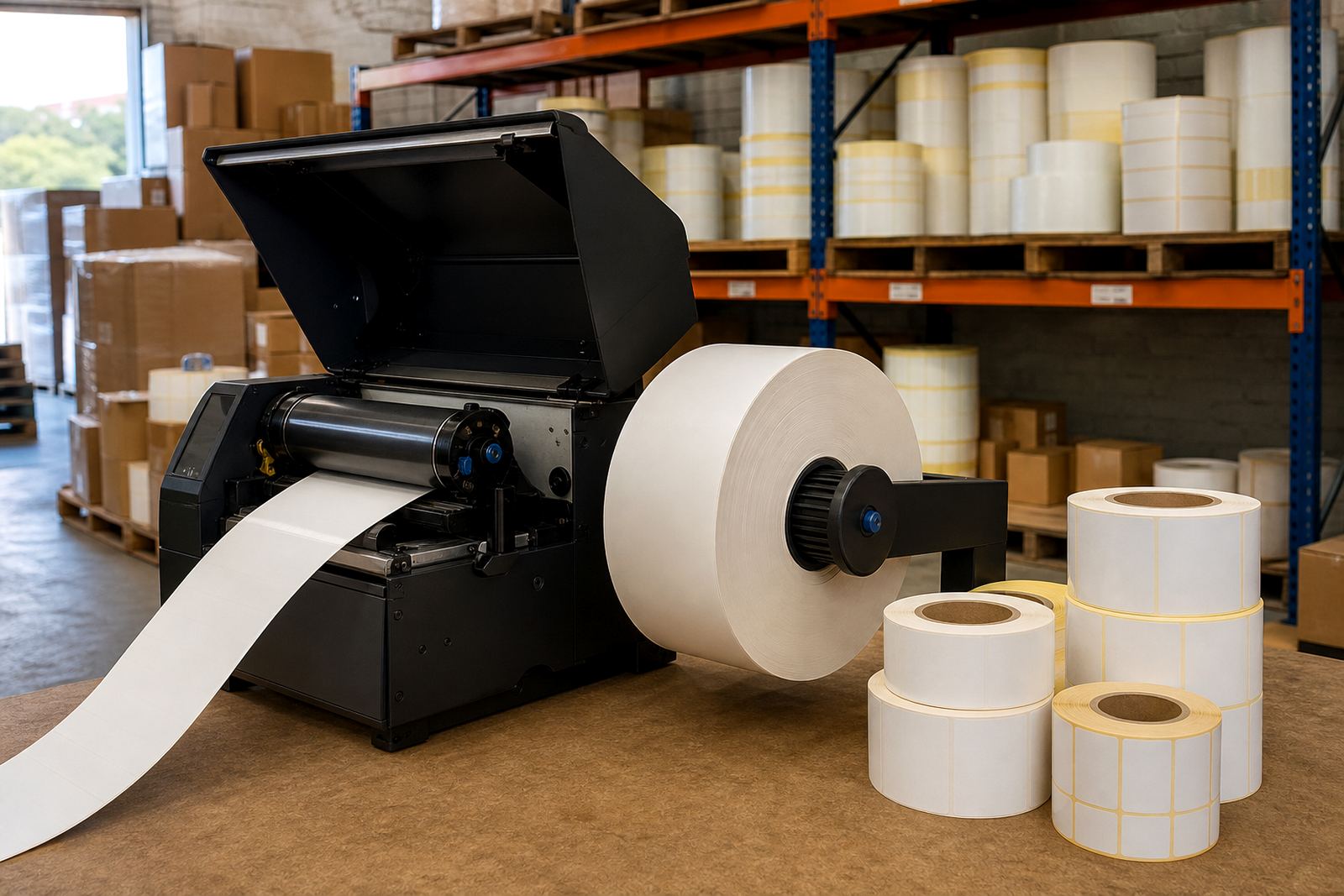
Industrial printers in warehouses and production areas move through bigger label volumes, wider formats and longer shifts than office units. That changes what matters. A roll that feeds well on paper in the morning can start giving trouble once the room heats up, the line speeds up or the operator is working with gloves on.
When choosing industrial printer rolls, start with the use case. Shipping labels, drum labels, pallet labels and carton marks all behave differently. A courier label for a Durban dispatch floor may need a clean peel and quick scan, while a manufacturing label in Pinetown may need better resistance to handling, oil or light abrasion. The roll must match the job, not just the printer model.
For bigger printers, small details matter: winding direction, core size, roll diameter and how tightly the roll is packed. A roll that is too heavy or wound unevenly can cause feed slips, skewing and unnecessary stoppages. On a busy line that becomes expensive very quickly.
Face stock, adhesive and liner: the three parts that do the real work
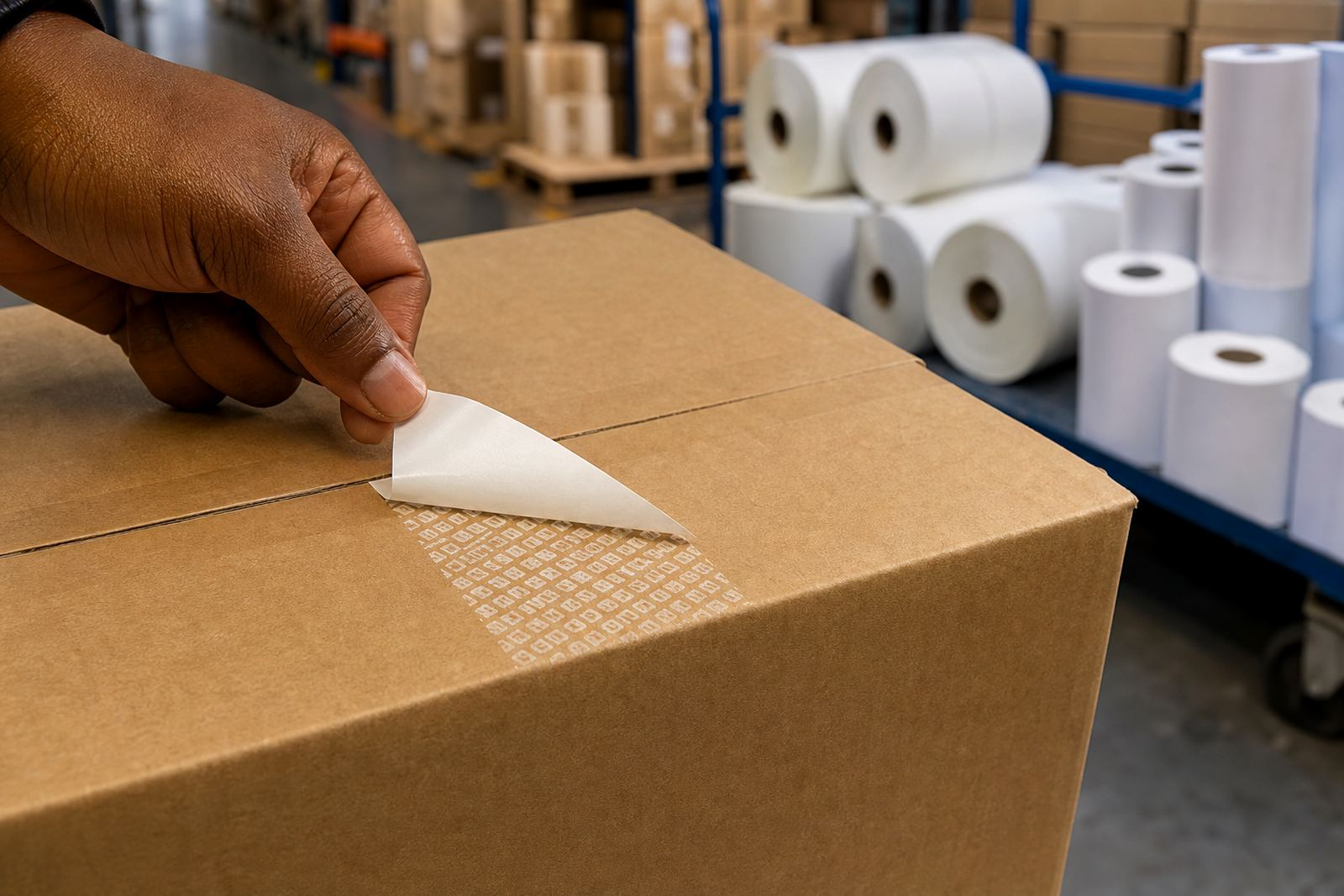
Industrial label stock is usually built from three layers. The face stock is the printable surface, the adhesive bonds the label to the pack or carton, and the liner carries the roll through the printer before peel-off. Each layer needs to suit the surface and the environment.
Face stocks can be paper or film-based. Paper face stock is common for general packaging and short-life labels. Film-based stocks are used where extra resistance to moisture, rubbing or rough handling is needed. In coastal areas like Durban, humidity can affect both the label face and the adhesive if the wrong combination is used.
Adhesives are not one-size-fits-all. Some are made for dry cartons, others for chilled rooms, textured plastics or recycled board. A strong adhesive on the wrong surface can leave edge lift or ooze, while a light adhesive can fail on dusty or curved packs.
- Paper face stock suits many carton and dispatch labels
- Film face stock is better where moisture or handling is a concern
- Permanent adhesive is common for sealed packs and traceability labels
- Removable adhesive is used where labels must peel cleanly
- Liner choice affects feed, dispensing and waste handling
Direct thermal or thermal transfer, that is the main fork in the road
Industrial printers usually run either direct thermal or thermal transfer. The difference is worth understanding before ordering rolls, because the wrong media will waste time and ribbons or produce weak print.
Direct thermal labels are heat-sensitive. The printhead creates the image directly on the label face, so there is no ribbon. This is useful for shorter-life labels, delivery labels and some warehouse use, especially where fast turnaround matters. The print can fade with heat, sun or long storage, so it is not ideal for every warehouse task.
Thermal transfer uses a ribbon between the printhead and the label. This gives a tougher print and is often preferred for barcodes, product identification and labels that must last longer in storage or transport. If your labels travel from Johannesburg to Cape Town in mixed conditions, or sit in a storeroom for weeks, thermal transfer often makes more sense.
Good planning also helps with ribbon economy. The wrong face stock can waste ribbon through poor release, while the wrong ribbon width can leave exposed printhead areas. That is where printer fit checks and roll planning help avoid avoidable downtime.
Core size, roll length and winding direction decide whether the printer keeps moving
Industrial printers are more forgiving than small benchtop units, but they still need the roll to be built correctly. Core size must suit the spindle and holder. Common core sizes are used across different printer types, yet the exact fit matters. A roll that rocks on the spindle or binds on the holder can pull the media off line.
Roll length planning is equally important. A warehouse team may want fewer changeovers, but a roll that is too large for the printer bay can cause loading issues. The safe balance is a roll that gives useful runtime without straining the machine or the operator.
Winding direction also affects print and dispense. If the print face is facing the wrong way, the roll may not register correctly in the sensor path or may not present cleanly to the applicator. For labelers on production lines, a reversed roll can stop the line in minutes.
- Check the core diameter against the printer shaft and guides
- Confirm the maximum roll diameter the printer can carry
- Match the winding direction to the print path and applicator
- Keep label width within the printer’s usable range
- Allow for sensor gaps, black marks or register marks where needed
Factory floors and coastal humidity change the rules
South African sites vary a lot. A factory in Westmead may run in warm conditions with dust from packing areas, while a warehouse in Pietermaritzburg may need labels that hold up through seasonal cold and morning moisture. A coastal site in Durban has its own challenge with humidity, especially on carton stock that sits near loading bays.
Power interruptions also matter.If the adhesive is too weak or the liner too light, the first run after power returns may misfeed or leave labels lifting at the edges.
For these reasons, industrial printer rolls should be tested in the same conditions they will face on site. A sample roll can show whether the label peels cleanly, feeds straight and prints sharply on your actual printer. That is cheaper than discovering a problem after a shift has already started.
A practical fit check for busy sites in Pinetown, Durban and beyond
One of the most useful habits is to treat label selection as part of production planning. A packaging line in Pinetown, for example, may run cartons in the morning, then shift to pallet labels in the afternoon. If the stock and roll build are not planned properly, operators end up swapping rolls too often or forcing media that is not right for the job.
When reviewing a new roll for warehouse or factory use, look at the whole chain from printer to dispatch table:
- Printer type and print method
- Label size and orientation
- Core size and roll diameter
- Adhesive strength for the surface
- Storage conditions on site
- Whether the label must last days, weeks or only a single trip
For multi-site operations, consistency matters too. A label that works in Cape Town should behave the same in Pretoria if the printers and materials are matched properly. That reduces training time and cuts down on rejected rolls at receiving.
At Label Paper, the focus is on matching industrial printer rolls to the way the site actually runs. That includes custom slitting, rewinding, core sizing, roll length planning, winding direction, sample rolls, adhesive matching and printer fit checks, so the label stock arrives ready for the printer and the shift ahead.
What to ask before the next dispatch run
Before ordering, it helps to confirm the label use in plain terms. Is the label for a carton, a pallet, a drum or a shelf edge? Will it be scanned once or handled many times? Is it going through a thermal printer on the line or a heavier industrial unit in the packing room?
If the answer changes from one department to another, the label spec may need to change too. That is normal in retail distribution and manufacturing. The best roll is the one that keeps the printer running, holds through the journey and still scans properly at the end.
Clients across Durban, Johannesburg, Cape Town, Pretoria and Pietermaritzburg can send through the enquiry form on our contact page for help with roll planning, sample rolls and printer compatibility checks.