A Midrand brief built around moving work, not retail shelves
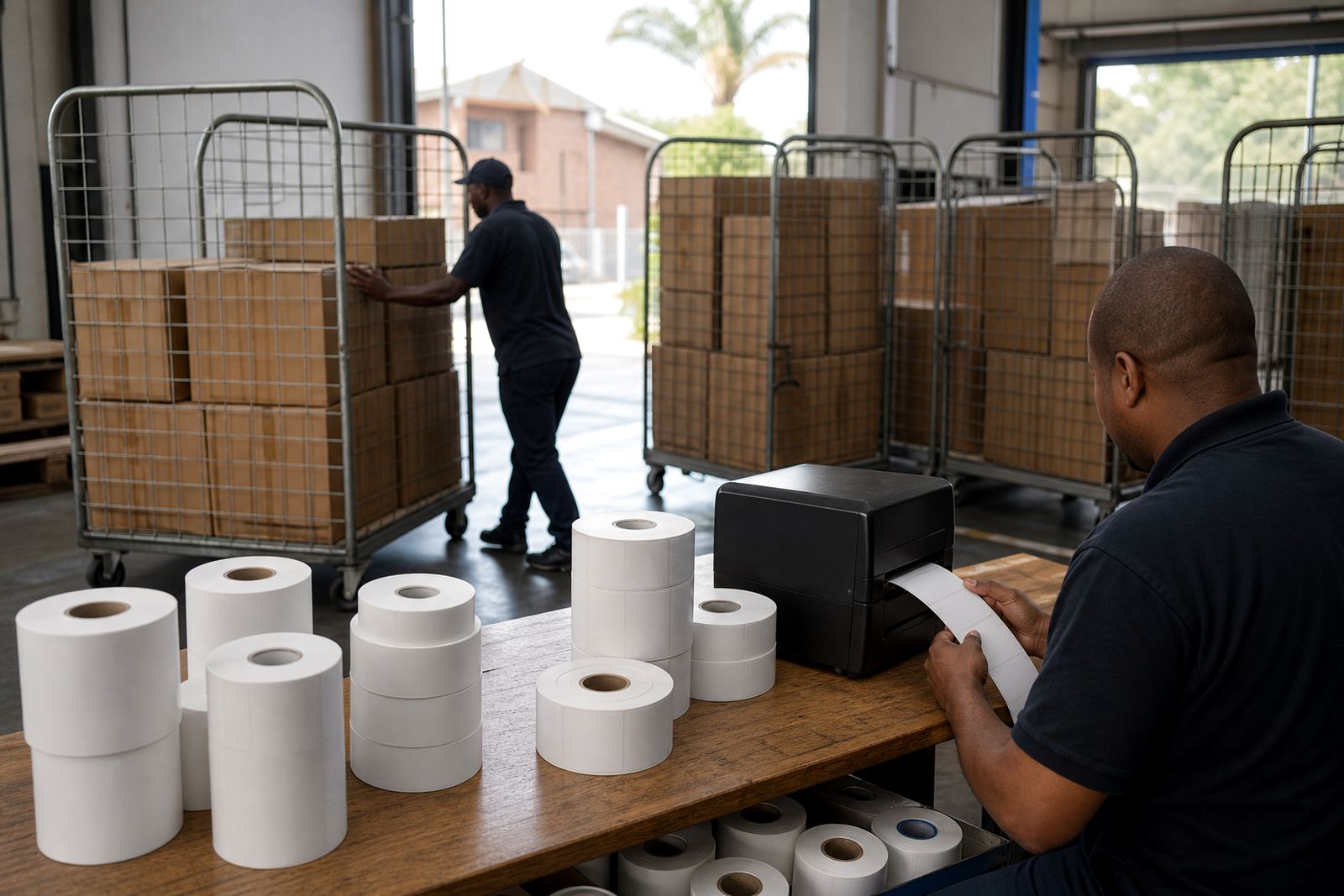
The request came from a Midrand manufacturing and warehouse operation handling work-in-progress movement between production, packing and dispatch. Their team needed labels for trays, bins, tote boxes and outer cartons so each stage could be scanned and tracked without slowing the line.
The brief was practical: labels had to stay readable through handling, brief rubbing, and the occasional temperature change between floor areas and dispatch bays. They also needed a format that would work across different printer stations, because one team was printing at the pack line while another was printing in a small goods-out room with limited space.
We mapped the job around the actual use case, not just the wording on the label. That meant checking the surface, the code size, the printer type and the strip or roll format before anything was cut.
The constraints that mattered on the floor
Midrand work zones can be busy, with dust from pallets, fork truck movement and stop start printing during shift changes. Labels that are fine on a clean office file might fail quickly on corrugated board, coated plastic totes or slightly textured surfaces. The client also wanted a solution that would still read properly under handheld scanners after storage and transport.
- Print clarity had to hold for barcodes, batch numbers and short process notes
- The adhesive needed to grip to carton board and plastic containers
- Roll sizes had to fit the printers already in use
- Labels needed to feed cleanly, with no edge curl or liner breakage
- Stock had to suit regular loading and reloading across shifts
When power returns, operators often restart print jobs quickly, so roll winding and core fit need to be right the first time. A mis wound roll wastes time when a line is waiting and the goods must move.
Face stock, adhesive and liner matched to the job
For this project we supplied self-adhesive label stock with a face material suited to clean print and clear scanning. In practice that means a smooth surface that accepts thermal transfer ink well, or direct thermal coating where the use window is shorter and the print is not expected to last as long in heat or sunlight.
The adhesive choice was matched to the surfaces in use. For carton and paperboard we used a general-purpose permanent adhesive. For plastic trays and returnable containers we allowed for a stronger tack option, because those surfaces can carry mould release residue or light dust. The liner was specified for stable release through the printer, so labels could peel properly without lifting prematurely.
- Thermal transfer rolls for longer-lasting labels and better resistance to rubbing
- Direct thermal rolls for short-life labels where ribbon is not required
- Core sizes set to suit the printer model, typically 25 mm, 40 mm or 76 mm
- Winding direction checked so the first label feeds out correctly
- Widths planned to match the barcode and wording without waste
The result was a stock set that was practical for day-to-day production, not over specified for the sake of it.
What we cut, rewound and checked before dispatch
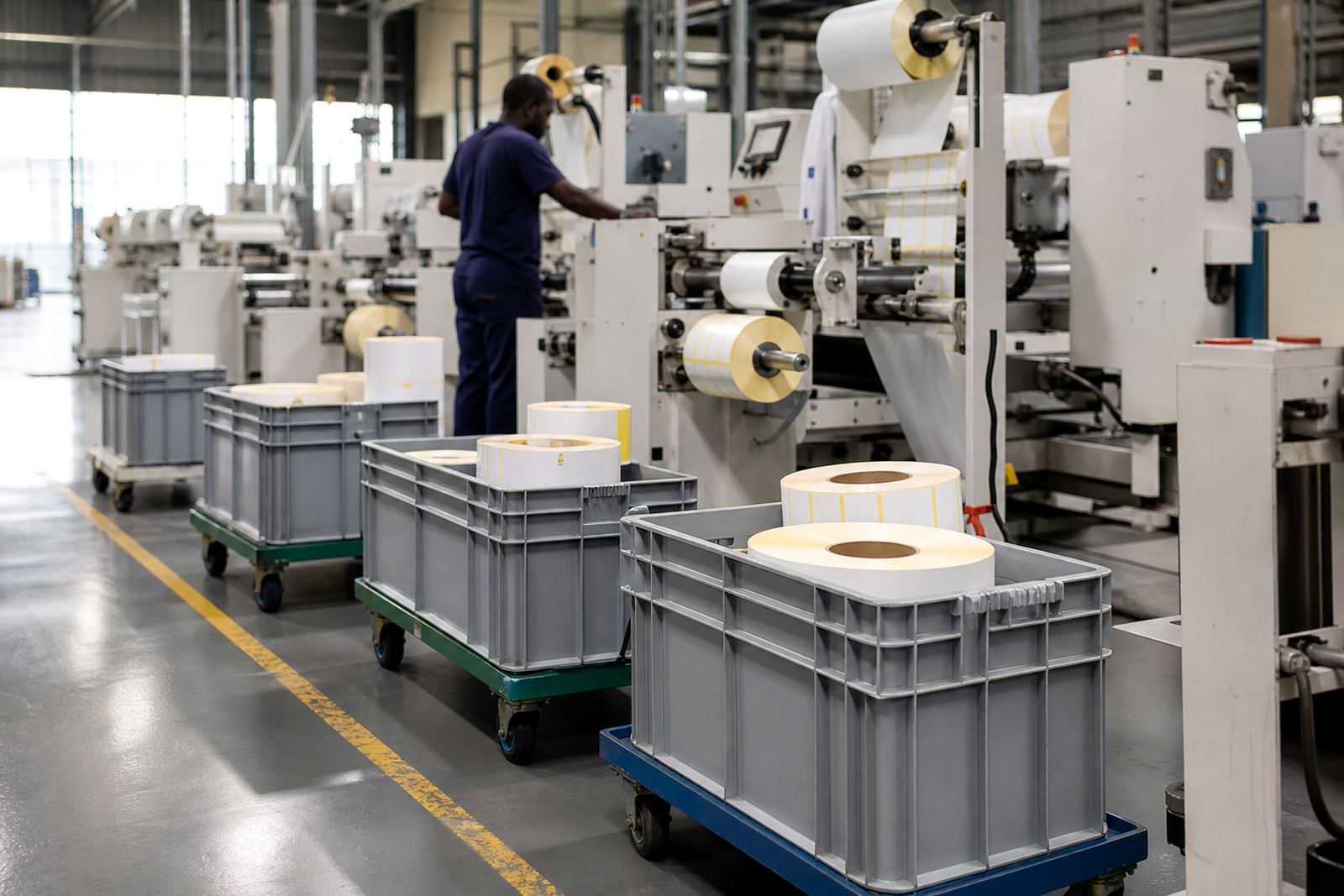
We supplied a set of sample rolls first, then adjusted the specification after the operators tested them on the actual printers and scanners. Once confirmed, the production rolls were slit to the required widths, rewound to the planned length and packed for clean issue at the site.
We also carried out printer fit checks against the current equipment. That included confirming core diameter, roll outside size, label gap or black mark detection, and whether the printer was using thermal transfer ribbon or direct thermal media. These small checks prevent feed errors that waste labels during busy shifts.
- Custom slitting to the required widths
- Rewinding for tidy roll presentation and stable feeding
- Core sizing to suit benchtop and light industrial printers
- Roll length planning for fewer roll changes during production runs
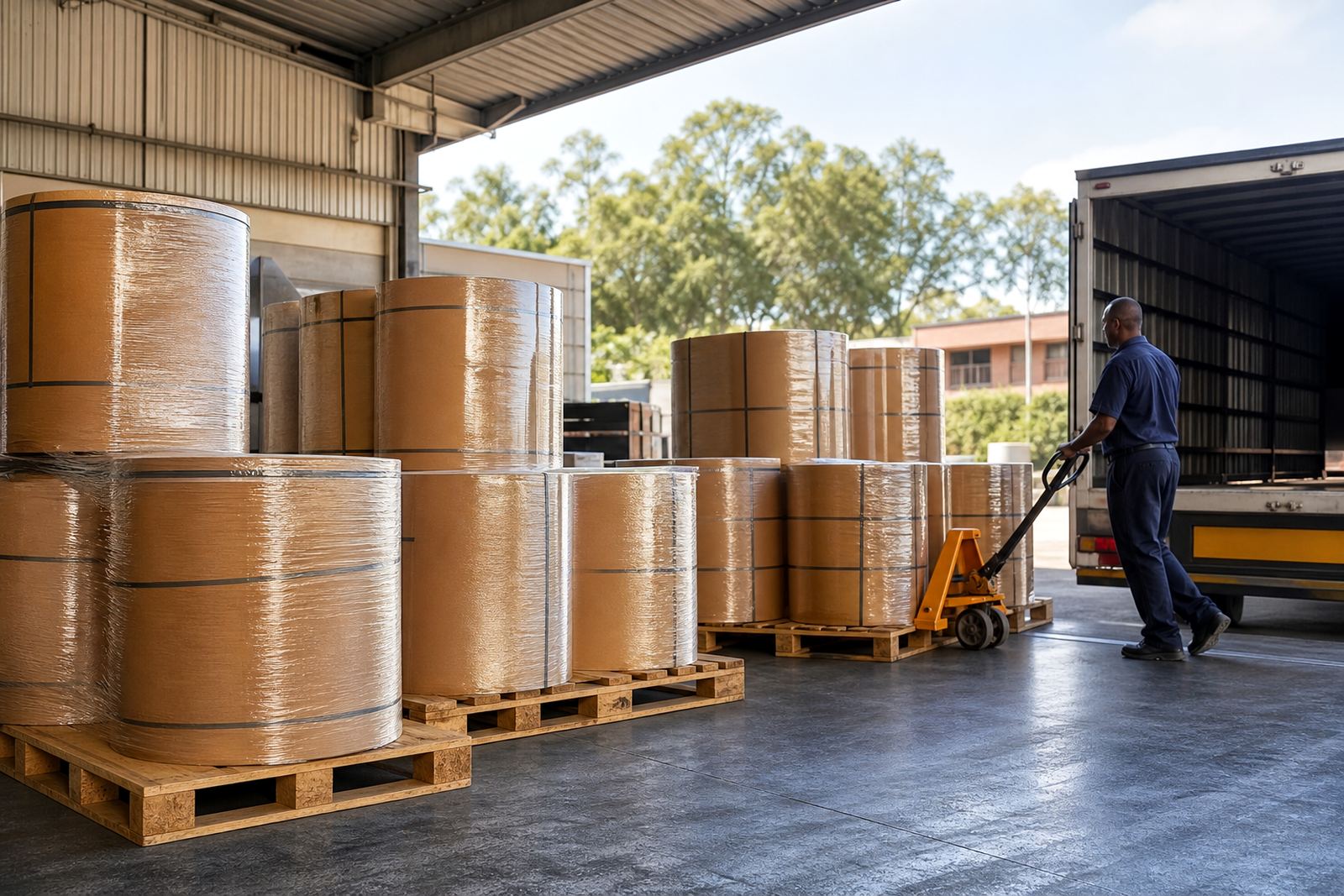
- Dispatch packing for safe transport to Midrand
We kept the pack counts practical for store room handling, so the client could issue rolls in manageable quantities rather than opening everything at once.
How the job moved from sample to full supply
The full turnaround took three weeks from first enquiry to delivery of the confirmed production rolls. Week one covered the brief, printer details and surface testing. Week two was sample issue and operator feedback. Week three was final slitting, rewinding, packing and dispatch.
That timeline worked because the client was clear about the application from the start. They knew the labels were for work-in-progress movement, not final retail display, so we could prioritise scan reliability, adhesive hold and printer compatibility over decorative finish.
Once the first batch was running, the team could move labels through receiving, assembly, staging and dispatch with fewer interruptions. The labels scanned properly, stayed legible after handling and gave the production staff a cleaner way to identify which batch was where.
What changed after the first production run
After rollout, the site reported fewer reprints and less time spent sorting out poor feed on the printers. The labels held on to cartons and plastic containers without lifting at the corners, and the code areas stayed clean enough for handheld scanning. That matters in a plant where items move quickly and there is not much time to relabel a tray twice.
There was also a practical saving in setup time. Because the roll lengths and cores were planned around the existing printers, operators did not have to keep adjusting feed settings or stop as often to replace rolls. In short, the labels fit the workflow instead of forcing the workflow to fit the labels.
- Cleaner scan results at packing and dispatch
- Less waste from misfeeds and rejected prints
- Better hold on carton board and plastic containers
- Fewer roll changes during busy shifts
- Consistent output across more than one printer station
Repeat setups for another Pinetown site
We would repeat the same sequence for any Midrand operation with moving stock or work-in-progress movement: check the printer, check the surface, test the label in a real shift and confirm the roll build before committing to volume. That process keeps the outcome grounded in the actual job, which is what matters when labels have to move with the goods.
For sites in Midrand, Johannesburg, Pretoria or anywhere else in South Africa, the same approach works across packaging, retail back rooms and logistics floors. If the label must scan, stay put and feed properly on the printer then the stock spec has to be right from the start.
Label Paper supplies self-adhesive label stock and thermal rolls from Westmead, Pinetown, with dispatch support to Durban, Johannesburg, Cape Town, Pretoria and Pietermaritzburg.
Key facts
| Project | Midrand Workflow Rolls |
|---|---|
| Town | Midrand |
| Client type | Manufacturing and warehouse operation |
| Application | Work-in-progress movement and barcode scanning |
| Supply format | Self-adhesive label stock and thermal rolls |
| Turnaround | 3 weeks |