Drums, decanting points and the label that must stay put
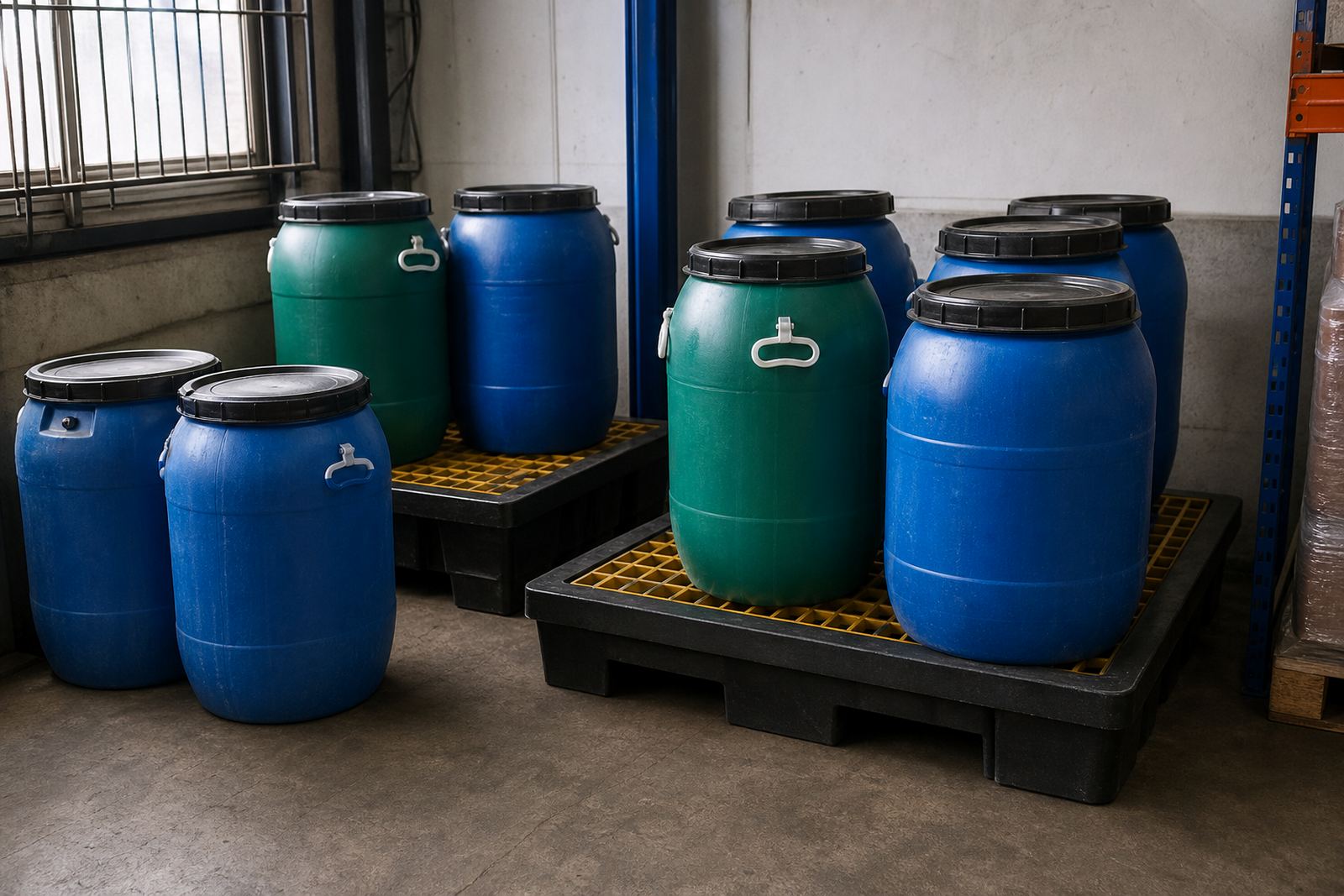
In controlled industrial settings, a drum label has one job: identify the contents fast and keep that information on the container through storage, transport and use. Chemical drums may be moved in warm loading bays, stacked in warehouses, or kept in coastal humidity where paper edges can lift if the wrong adhesive is chosen. For this use, the stock must suit the drum surface as much as the print process.
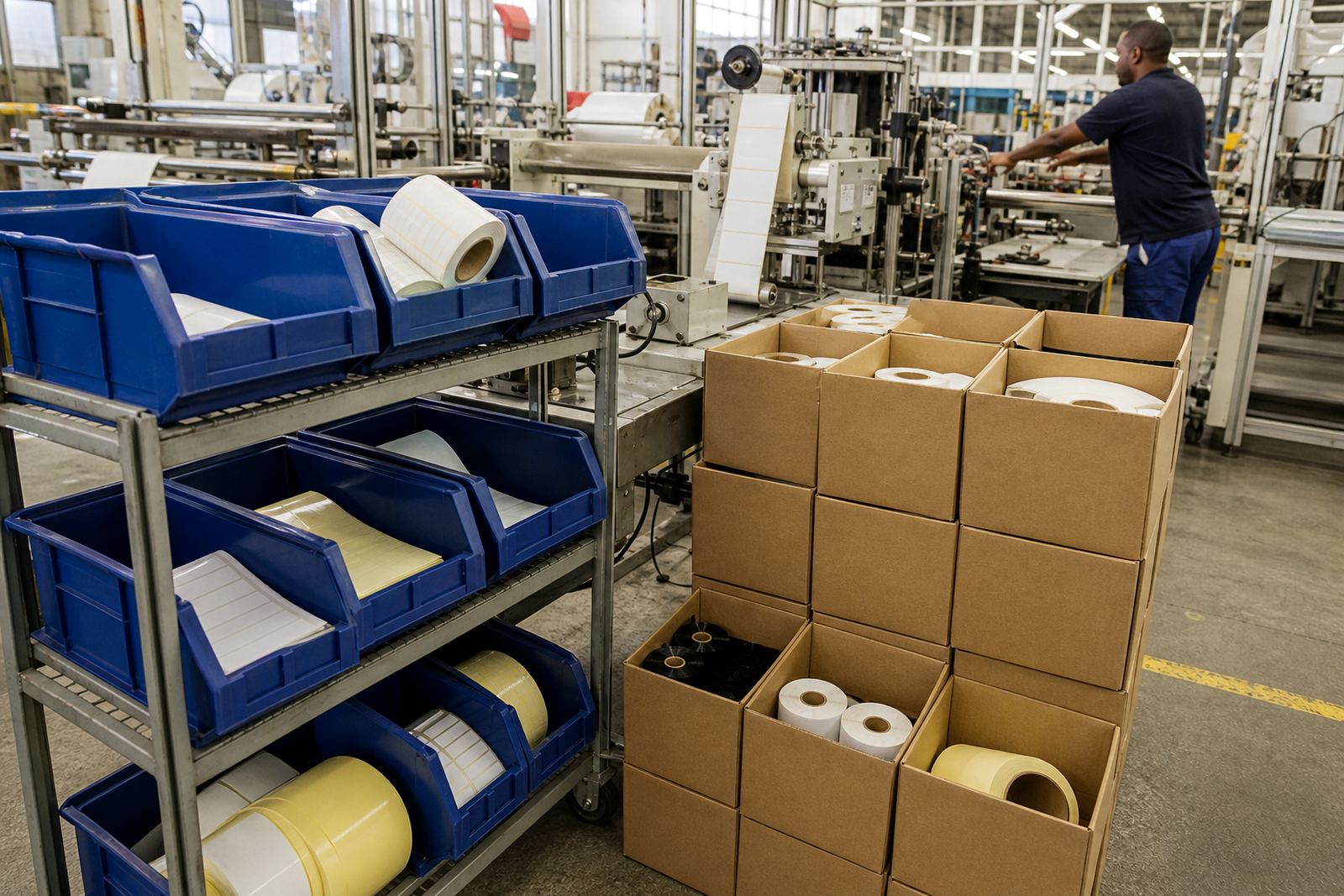
The most common request is for self-adhesive label stock that can be slit to the needed width, supplied on rolls that run cleanly through benchtop or industrial printers. We work with users who mark cleaning compounds, solvents, lubricants, degreasers and process additives. The layout often needs room for product name, batch code, hazard wording, date codes and internal stock references, all arranged so the drum stays easy to read in storage and when moved around the plant.
Because drums are often wiped before application, adhesion matters as much as print quality. A label that looks fine in the office can fail on a slightly curved container, or one that was handled with gloves after filling. That is where face stock, adhesive grade and liner release all need to match the job.
Face stock, adhesive and liner choices that suit industrial drums
For chemical drum marking, the face stock is usually chosen for print clarity and handling strength. Paper face stock is useful for dry indoor storage and shorter life marking, while synthetic face stock is better where moisture, rubbing or repeated handling are part of the day. Smooth topcoated papers can give good print definition for codes and batch text, but on some sites a more durable film face stock is the safer option.
Adhesive choice depends on the drum material and surface condition. A general purpose adhesive may work on clean, dry containers, but many industrial users need a stronger tack for curved drums or a formulation that grips better on slightly textured plastic. For colder stores or humid coastal conditions, the adhesive needs to hold its bond without edge lift. We also look at whether the label must be removable, permanent, or simply fixed for the life of the drum.
The liner matters too, especially where labels are applied by hand or through dispensers. A stable liner gives cleaner peel-off and less waste. If the roll is being cut or rewound for a specific line, the liner caliper and release should suit the printer and applicator setup. A poor liner choice causes jams, slow application and wrinkled labels that are hard to save.
- Paper face stock for short to medium life marking in dry storage
- Synthetic face stock for moisture, abrasion and frequent handling
- Permanent adhesive for drums that must stay marked through the full cycle
- Removable adhesive for returnable containers or rework areas
- Matched liner release for hand application, dispensing or printer feed consistency
Direct thermal or thermal transfer, and which core size fits the printer
Thermal rolls for chemical drum marking usually fall into two groups. Direct thermal stock prints through heat alone and is handy for short life labels, job tickets and fast-moving internal marking. Thermal transfer uses a ribbon, which gives better resistance to rubbing, some chemicals and sunlight. If the label must survive in a yard, on a shipping drum or near a wash area, thermal transfer is usually the more practical route.
Printer compatibility is part of the planning. Many smaller printers use 25 mm or 40 mm cores, while wider industrial printers can take 76 mm cores and longer roll lengths. The outside diameter must also suit the printer compartment so the roll feeds smoothly without bunching. Some sites run benchtop units for small batch marking and a wider printer for dispatch labels, so we match the roll size to the actual machine on the floor, not only the nominal label width.
Common checks before supply include label width, roll length, winding direction, gap or black mark sensing and whether the printer needs a face-in or face-out roll. A misfeed on a chemical line is not only annoying, it can slow packing and lead to repeated reprinting. If the drums are marked on more than one station, it helps to keep the same core size and roll build across the site.
- Direct thermal for short-life internal identification and quick batch changes
- Thermal transfer for longer life and better resistance to abrasion
- 25 mm cores for compact printers and smaller roll builds
- 76 mm cores for industrial printers and higher volume use
- Winding direction matched to the printer path and sensor setup
How to lay out a chemical drum label so the line can read it fast
The strongest drum label is not only about material, it also needs a practical layout. In a busy plant the operator should find the product name first, then the batch or fill code, then any handling note. Font size must stay readable from a short distance, and the label should avoid cramming too much into one panel. If the drum has a curved side, a wider label may need a shorter text block so the edges do not lift.
We normally look at the drum size, the marking position and whether the label will go on plastic, steel or a coated drum. A label on a 25 litre container has different needs from one on a 200 litre drum. If there is a barcode, it needs enough quiet space around it for scanning. If there are multiple product families, colour coding can help, but the print contrast must still be clear in low light and under warehouse dust.
Planning also covers stock movement. If your filling line uses several drum types, it helps to keep the label width and repeat length consistent where possible. That reduces conversion changes and makes repeat order planning easier. A small change in width or gap can force a different roll build, so the art and the stock need to be checked together.
Mistakes that cause lifted corners, bad scans and wasted rolls
We see a few common issues on chemical drum marking jobs. The first is choosing a face stock that looks good but does not suit the surface or environment. The second is using a thermal option where a transfer print should have been specified, which can leave marks fading too quickly. Another frequent mistake is ignoring the printer's core size and roll diameter, then finding that the roll is too large for the housing or feeds unevenly.
Application conditions matter as well. Dust, oil, condensation and rough handling can all reduce adhesion. If drums are filled and labelled too quickly after washing or decanting, the label may lift at the edges. In some plants the label is applied before the container has fully cooled, which can also affect bond strength. It is better to match the adhesive to the actual process rather than force a general label to do every job.
Another issue is under-specifying the text layout. If the label carries too many fields, the print becomes small and difficult to check. That leads to relabelling, spoiled stock and delays. For a chemical drum line, clarity usually saves more money than squeezing everything onto one small panel.
- Wrong adhesive for the drum surface or storage area
- Direct thermal used where a longer life print is needed
- Roll size or core size that does not fit the printer
- Too much text packed into one label panel
- Labels applied before the surface is ready
Budget ranges in Rand for drum marking stock and repeat runs
Budgets vary by face stock, adhesive, roll length and print method. As a broad working range, basic paper label stock for short life industrial marking can sit at the lower end, while synthetic material with a stronger adhesive and transfer print compatibility sits higher. Direct thermal rolls are often the more economical option for short use jobs, but if the mark must stay legible for longer, thermal transfer usually gives better value over time.
For small batch users, the spend may stay in a modest monthly range if the drums are marked in one or two sizes and the rolls are straightforward. Larger operations that need several widths, custom slitting, rewinding and repeat planning should budget more for conversion work and stock variety. A typical planning conversation may cover a few hundred Rand for small sample or trial runs, then move into larger supply values once the right build is confirmed.
We also help with sample rolls, repeat order planning and usage review so the same drum line does not keep changing stock without reason. When the right label build is matched to the printer and the surface, the job runs cleaner and waste drops. That saves both time and money, especially in plants with multiple filling points and seasonal volume swings.