When the carton has to speak for itself
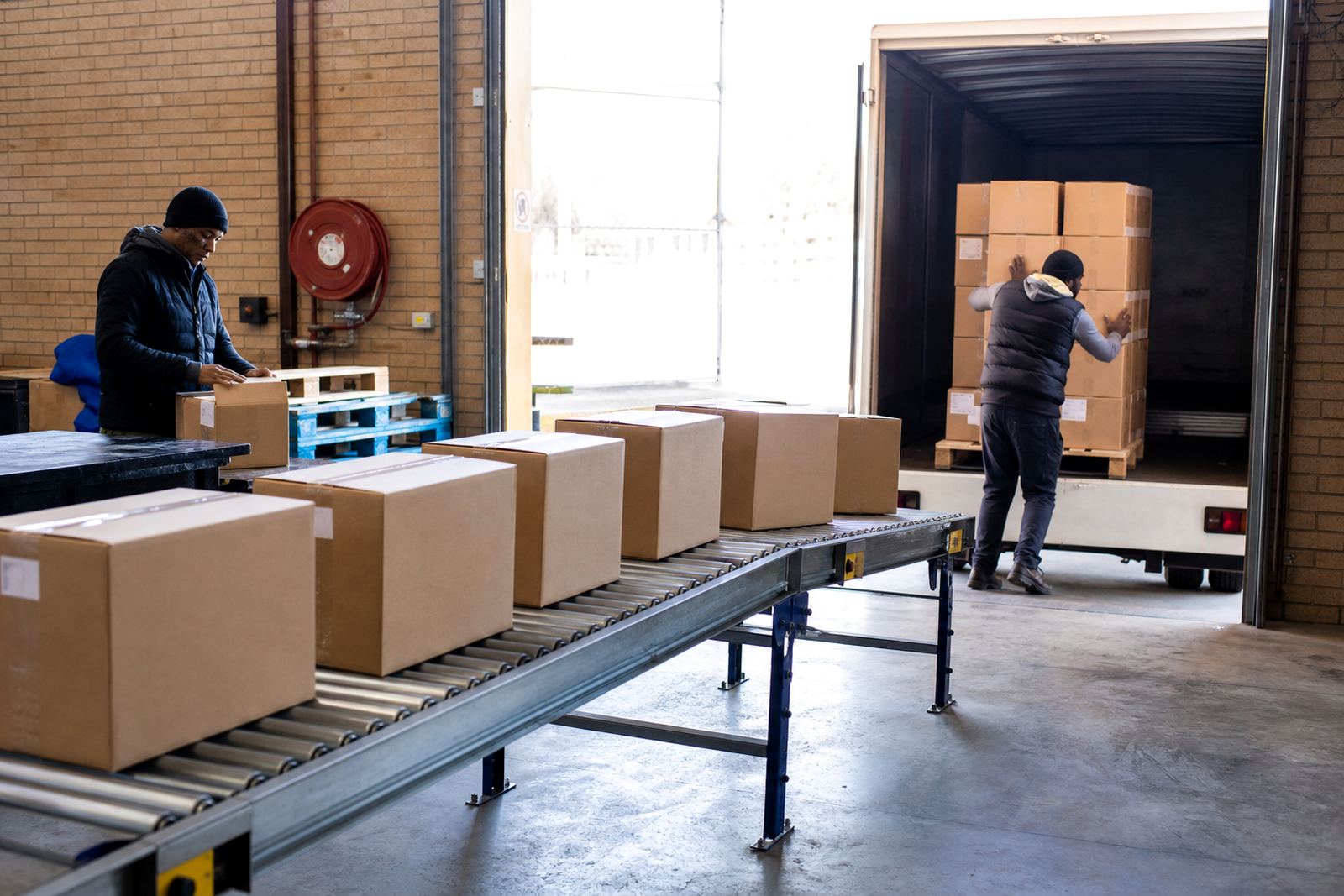
Outer carton labels carry more weight than many people expect. They tell the warehouse team what is inside, where it is going, which batch it belongs to and whether it is ready for dispatch, rework or quarantine. In busy operations around Westmead, Pinetown and Hammarsdale, a carton mark has to stay legible after stacking, tape pressure, shrink wrap and a day in a warm truck.
For carton identification, the label choice usually starts with the pack type and the surface. Plain corrugated board, coated cartons, recycled board and lightly dusty boxes each behave differently. A paper face stock can work well for indoor storage and general packing, while a synthetic face stock is often chosen where moisture, scuffing or cold-room handling is part of the process. The wrong adhesive can lift at the corners, shift on dusty board, or leave a label that looks fine on day one but fails before the goods reach Johannesburg or Cape Town.
We supply label stock for businesses that need clear carton identification without overcomplicating the process. That includes carton labels for product codes, contents, weights, shelf routing, and route sorting in retail, logistics and manufacturing.
What usually goes onto an outer carton label
A good carton label must be easy to read at arm’s length and still make sense after a courier scan or warehouse check. The layout normally depends on how the goods move through the building and what the receiving team needs first.
- Product name or carton content code
- Batch number, lot number or job reference
- Quantity per carton and pack count
- Destination, route or store code
- Handling notes such as fragile, keep dry or this way up
- Barcode or sequence number for internal tracking
In practice, a carton label should not be overloaded. Too much text in one box makes it harder for pickers and dispatch staff to read quickly. A neat layout with enough white space helps more than cramming every detail onto one label. For many sites, a 100 mm by 150 mm label works well for carton faces, while larger cartons may need 150 mm by 100 mm or A5-style formats depending on printer width and the information shown.
If the label is being read in a receiving bay with mixed lighting or if goods move through a dusty yard, darker print on a high-contrast face stock is usually worth the extra care.
Printer set-ups that suit carton marking work
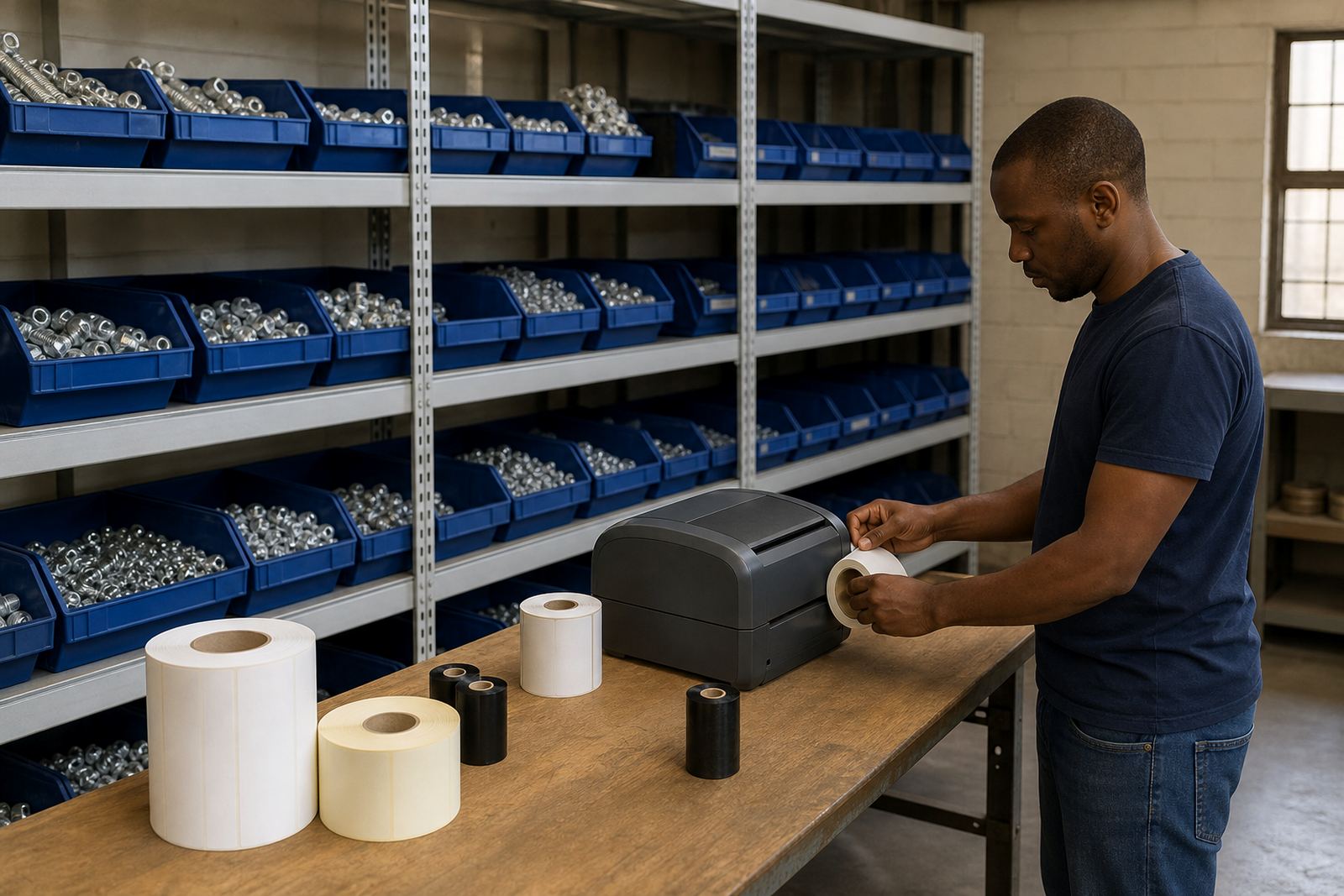
Carton identification is commonly produced on benchtop or industrial label printers using direct thermal or thermal transfer printing. Direct thermal is used where the label is needed for shorter-term use and where speed matters, since there is no ribbon involved. Thermal transfer is better where the carton will sit in a store room, travel through humid conditions, or remain readable for longer periods.
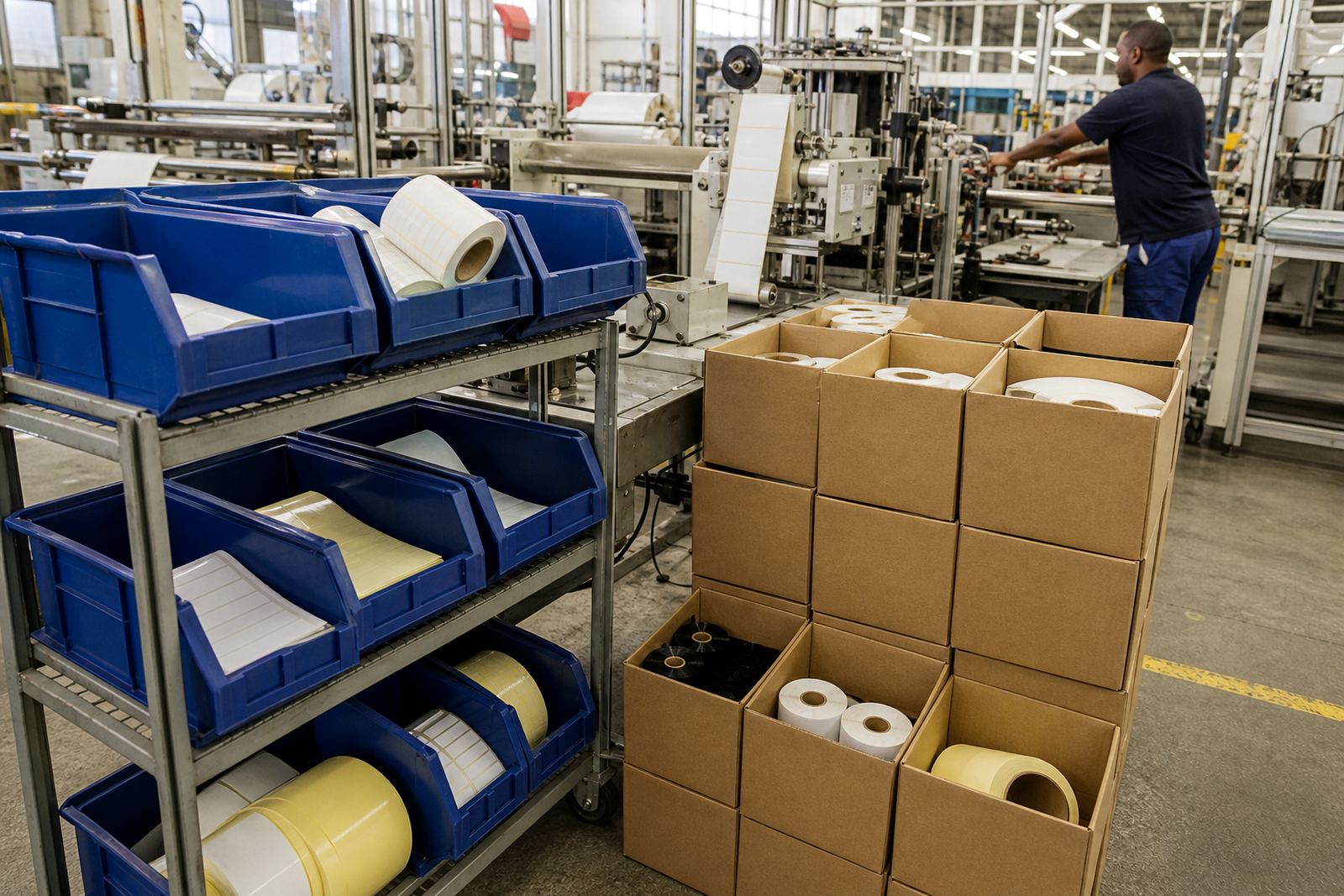
The printer fit has to be checked properly. Core size, roll diameter, unwind direction and outer width all affect whether the roll feeds correctly. A roll that is too large for the printer bay can cause stoppages, crooked prints or wasted labels. Most carton work uses 25 mm, 38 mm or 76 mm cores depending on the machine, with roll lengths planned around how often the line can stop to reload.
- Direct thermal for shorter-life labels and fast printing
- Thermal transfer for longer life, better durability and rub resistance
- Paper face stock for clean, dry carton surfaces
- Synthetic face stock for moisture, handling wear and cold storage
- Permanent adhesive for most carton applications, removable only when required
We also check winding direction and printer orientation before a roll is supplied, because a good label on the wrong wind can waste time across the whole shift.
Adhesives, face stocks and liners that suit South African conditions
Westmead, Durban and many inland depots deal with different conditions across the same week. Coastal humidity can soften poor adhesive performance, while warehouse dust can reduce grip on corrugated board. That is why carton identification needs the right match between face stock, adhesive and liner.
Face stock is the printed top layer. Paper is common for general packing and carton marking, while synthetic materials are often selected where scuffing, moisture or condensation is a concern. Adhesive choice depends on the carton surface and how long the label must stay put. Permanent adhesive is standard for packed goods that should stay identified right through transport and storage. Some cartons need a high-tack adhesive for rough board, while freezer or chilled work calls for a different glue build-up entirely.
The liner also matters. A stable liner helps feeding through the printer and keeps the label release clean. If the liner is not matched to the printer or label width, the machine may skew or struggle on longer runs. That leads to misreads at packing stations and extra hand checking by staff.
For many carton identification jobs, the real value is in matching the material to the environment rather than just choosing the cheapest roll. A small adjustment in adhesive or face stock can save a lot of rework later.
Layout planning that saves time at the pack table
Carton labels work best when the layout suits how the goods are handled. A label for a retail carton that will be scanned on one side only does not need the same design as a label for mixed pallets moving through a distribution hub. If the label is going onto a box that will be stacked under stretch wrap, the barcode and key text should sit where they are least likely to be hidden or scuffed.
Most teams do better with a clean hierarchy: product name or code first, then quantity, then destination or route. Where batch control matters, the batch number should be visible without turning the carton. If the carton is used in repeat dispatches, it helps to standardise label positions across all pack lines so staff do not waste time hunting for the printed face.
- Place labels on a flat panel, not over box joins or tape seams
- Keep barcodes away from corners and folds
- Use one standard size across similar cartons where possible
- Check print darkness before large runs
- Leave enough margin so torn edges do not affect scanning
For operations in Pretoria, Johannesburg and Pietermaritzburg, where cartons may move between multiple hands before delivery, a straightforward layout usually works better than a crowded one.
Common carton label mistakes and the cost of fixing them
The most common mistake is choosing a label that looks fine on the printer but fails on the box. That happens when the adhesive is too weak for recycled board, the face stock smudges too easily, or the label size is too small for the information being printed. Another frequent issue is using direct thermal when the label must last through heat, sun or longer storage. The print fades and then the carton is hard to identify at goods-in.
We also see problems where businesses order the wrong core size or roll width for their printer, which leads to stoppages and wasted stock. In some cases, the issue is not the roll itself but the winding direction, so the label exits the printer the wrong way and cannot be applied properly. These errors are small on paper but expensive on a busy line.
For budget planning, carton identification supplies can sit anywhere from about R180 to R650 per roll for common label sizes and general paper stocks, depending on width, length and print method. More specialised face stocks, longer rolls, custom slitting or adhesive matching can move that higher. A sample roll is often the best way to test fit, print clarity and board adhesion before placing a fuller order.
Label Paper supports carton identification work from our Westmead base with sample rolls, printer fit checks, roll length planning and repeat order planning for sites across South Africa.